AI Adaption Among HNWIs

The Need For An Emotional Auditor
I. Summary
Dating has moved beyond the era of simple matchmaking. For HNWIs, the entire digital presence is also an exercise in risk management. With a continuous growth of fraud online the dating landscape requires a higher standard: the protection of people’s emotional and psychological bandwidth. As sophisticated manipulation and digital social engineering become more prevalent, the challenge online is no longer just finding a partner but identifying authenticity in an increasingly filtered world. This report explores how Luxy sees the Emotional Firewall, using AI to act as a guardian of sincerity and a shield against psychological fatigue.
Data conducted for this report reveals a clear shift in user priorities: members are moving away from passive verification toward active, AI-assisted emotional intelligence.
Top Research Findings:
- The Intuition Trap: 70% of HNWIs still rely on "gut feeling" for vetting, yet this is the exact vulnerability exploited by sophisticated manipulators.
- Safety Over Convenience: 78% of users stated that protection from emotional and social risk is their top priority for AI, far outweighing the desire for automated scheduling.
- The Fear of the "Long Con": Financial risk remains high at 55%, but a significant 61% are specifically concerned about status-climbers using emotional manipulation to bypass traditional defenses.
- Strategic Wingman, Not Bot: Authenticity remains king. While 84% want an AI Coach to help them spot red flags and improve their own EQ, only 5.8% would trust an AI to actually write their messages.
In the study, we could find a 82.5% openness toward AI-assisted communication. The future of online dating is not about making the most matches, but about finding the right one, in the right way. By integrating an “Emotional Firewall”, Luxy can empower users to engage with confidence, ensuring their emotional investments are as secure as their financial ones.
II. Introduction: The Psychological Risk in Elite Dating
The Context: High Stakes in the Pursuit of Quality
For HNWIs, the quest for a life partner is is a high-stakes search for compatibility that usually balances their personal desire with the complexities of a busy professional life. Elite platforms like Luxy have become the preferred choice for this demographic, offering a curated environment where financial vetting and profile verification act as the first line of defense. By prioritizing "quality over quantity," Luxy addresses the primary demand of the elite: a serious, streamlined path to finding a partner who matches their lifestyle and values.
However, the very attributes that define the HNWI lifestyle—significant assets, public visibility, and limited time—create unique vulnerabilities. In this sphere, a "bad date" is not merely a wasted evening; it is a high-cost expenditure of non-renewable time. Furthermore, the necessity of maintaining a public or professional profile means that every new interaction carries an inherent risk to trust and authenticity. For the elite, the challenge is not just finding a partner, but doing so without compromising the security of their private world.
Psychological Defense besides Financial Security
While dating app Luxy has historically focused on protecting its HNWIs from financial fraud, there is a growing thought that psychological risks are equally damaging. Beyond the threat of "gold-digging," HNWIs face sophisticated forms of emotional manipulation, love bombing, and misaligned intentions that can lead to profound reputational damage and emotional exhaustion.
Luxy introduces the concept of the "Emotional Auditor." It represents a shift in dating safety: besides passive defense (blocking known bad actors) active detection (identifying subtle patterns of manipulation in real-time) might be necessary. Just as a financial auditor scrutinizes records for inconsistencies, an emotional auditor utilizes data to flag psychological red flags that the human heart, often clouded by initial chemistry, might overlook.
The Rise of AI: Beyond Efficiency to Emotional Intelligence
To date, Artificial Intelligence in the consumer space has been perceived primarily as a tool for efficiency, automating tasks, scheduling, or drafting generic correspondence. However, the untapped potential of AI lies in its ability to process nuances of language, sentiment, and behavioral patterns that escape the casual observer.
While current AI applications in dating are often viewed with skepticism regarding authenticity issues or inaccuracies, there is opportunity to use AI as a sophisticated layer of emotional intelligence. By analyzing communication styles and identifying coercive or inconsistent patterns, AI can serve as a "firewall" for the psyche, protecting the user's emotional well-being as rigorously as a firewall protects their data.
Report Objectives
This report analyzes the results of a survey conducted with 120 Luxy HNWIs to bridge the gap between technological capability and user need. Our objectives are:
- To quantify the exposure and concerns of HNWIs regarding psychological and reputational risks in the modern dating landscape.
- To gauge the appetite for AI-powered "Emotional Firewalls," identifying where users feel the technology adds value and where they remain skeptical.
- To explore the dual role of AI—not just as a vetting tool (an "Auditor"), but as a proactive "Emotional Intelligence Coach" that empowers users to refine their own boundaries and communication strategies.
Through this lens, we examine how Luxy can lead the industry in transforming AI from a convenience into an essential guardian of the elite dating experience.
III. The Vulnerabilities of Elite Dating: Why an Emotional Firewall is Needed
Dating platforms are not only a pool to get to know others easily but hold asymmetric risks. While HNWIs are looking for compatibility, they simultaneously have to navigate a minefield of ulterior motives, social engineering, and potential personal brand damage. The necessity of a so called "Emotional Firewall” becomes evident when we analyze the specific vulnerabilities of this demographic and the limitations of HNWIs current protection mechanisms. The Emotional Firewall is a proactive, AI-driven layer of psychological and strategic protection by giving additional information so the individual makes the right choices.
The Specialized Risks of the Elite Tier
The following is discussing vulnerabilities for HNWIs, and can be divided into psychological, emotional, financial and personal risks.
1. Financial Exploitation and the Persistence of Ulterior Motives
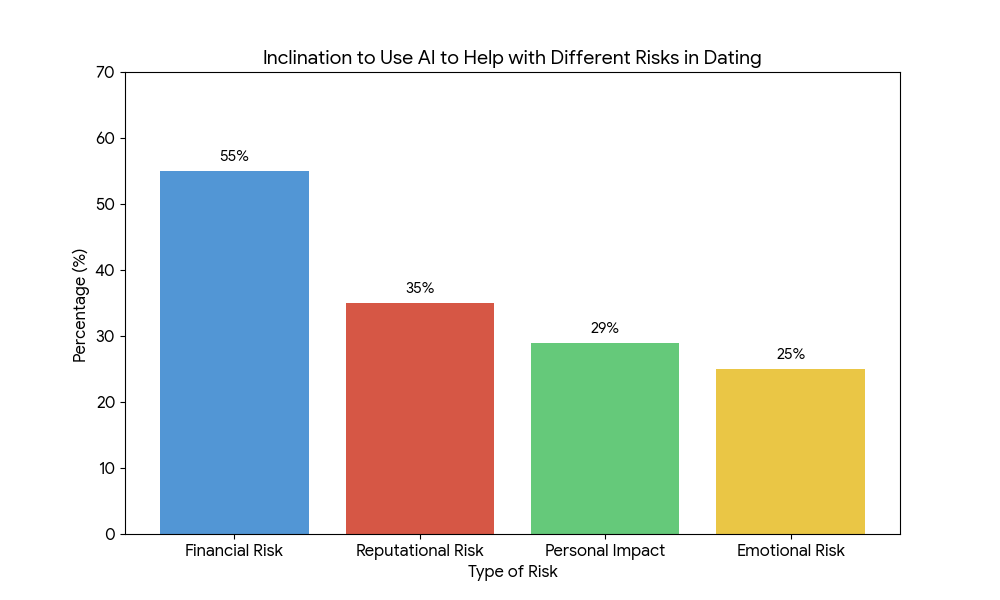
The threat of financial predation remains the most significant concern for the elite. Data from Luxy members indicates that 55% of HNWIs identify financial risk as a primary worry when meeting new people online. This is further supported by the fact that approximately 61% of high-net-worth daters report being "concerned" or "very concerned" about encountering individuals driven by financial gain or status climbing. These ulterior motives often manifest as "long cons," where the manipulator integrates themselves into the victim's life so deeply that the eventual financial or social extraction is devastating.
2. Reputational Fragility
For an HNWI, their reputation is often their most valuable asset. The survey data reveals that 35% of respondents view reputational risk as a major deterrent in digital dating.
3. Personal Brand Risk
Nearly 30% fear the personal impact of embarrassment or social fallout. In an era of cancel culture and instant digital sharing, a single interaction with a disingenuous individual can lead to blackmail, public scandal, or the erosion of a hard-won professional legacy.
4. The Cost of Time and Energy
Beyond tangible loss, the energy drain of vetting disingenuous partners is a significant vulnerability. HNWIs view time as their scarcest resource. The process of engaging with a partner only to realize weeks later that their intentions are insincere represents a massive "opportunity cost" that many are no longer willing to pay.
The Fallibility of Traditional Defenses
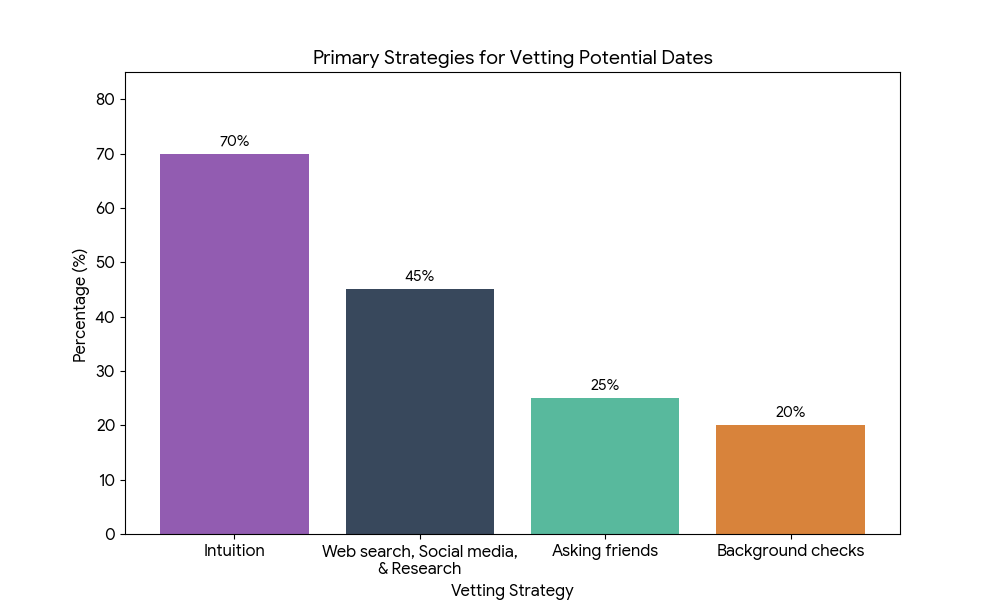
Despite these high stakes, the methods HNWIs currently use to protect themselves are largely reactive and subjective. Survey insights show a heavy reliance on gut feeling, with over 70% of HNWIs citing intuition as their primary vetting strategy. While intuition is a powerful human tool, it is easily deceived by professional manipulators who are trained to mirror the target’s values and desires.
Secondary strategies are equally limited:
- Manual Digital Vetting: While 45% of HNWIs perform their own web and social media searches, these efforts only uncover what is publicly available. They cannot detect a "clean" profile created specifically for a sophisticated scam.
- External Verification: Only 20% to 25% of individuals utilize formal background checks or consult friends. These methods are often perceived as too intrusive or "unromantic" for the early stages of a relationship, leaving a critical gap during the initial period of high vulnerability.
Luxy’s internal database insights highlight this gap. Even with robust platform-level protections like picture verification and manual profile vetting, users frequently report unusual behavior only after an interaction has begun. Trends show that users typically unmatch or block profiles when they notice subtle red flags: an early request to move to an encrypted messaging platform, a refusal to engage in a video call, or a communication style that feels "off" or scripted. These are behavioral markers that human intuition often catches too late—after emotional or temporal investment has already occurred.
The Imperative for an AI-Driven Emotional Firewall
The limitations of current coping mechanisms have created a clear demand for a more sophisticated, technological solution. When asked about their priorities for AI in social interactions, a staggering 78% of HNWIs expressed that protection from social and emotional risks is either their top priority or of equal importance to convenience.
This is where the concept of the Emotional Firewall becomes essential. Unlike traditional vetting, which is a one-time event (like a background check), an Emotional Firewall is a continuous, AI-powered layer of protection that operates during the interaction itself. It is useful for three primary reasons:
- Objective Pattern Recognition: AI can analyze linguistic patterns in real-time to detect the markers of manipulation, love bombing, or scripted communication that a human, blinded by attraction, might overlook.
- Early Warning Systems: By identifying off-platform requests or inconsistencies in a narrative across multiple days of conversation, the AI acts as a proactive shield, flagging risks before they escalate into financial or reputational threats.
- Preservation of Bandwidth: By automating the red flag detection process, the Emotional Firewall allows the HNWI to engage with more confidence and less defensive fatigue.
In conclusion, the elite dating experience is currently defined by a high level of anxiety regarding sincerity and safety. The data shows that HNWIs are acutely aware of their vulnerabilities but lack the tools to address them objectively. The Emotional Firewall represents a necessary evolution in dating technology, moving beyond simple matchmaking to provide a sophisticated, data-driven guardian for the user’s emotional and financial well-being.
IV. User Perceptions of AI as an Emotional Auditor
As the concept of the Emotional Firewall moves from theoretical framework to practical application, the willingness of HNWIs to adopt AI as a social intermediary becomes a critical focal point. The transition of AI from a productivity tool to an Emotional Auditor, a system capable of parsing subtext, intent, and risk, is already underway. Data suggests that while the elite are traditionally protective of their personal spheres, a significant majority now views AI-assisted social intelligence not as an intrusion, but as a necessary evolution of digital safety.
Awareness and the Adoption Threshold
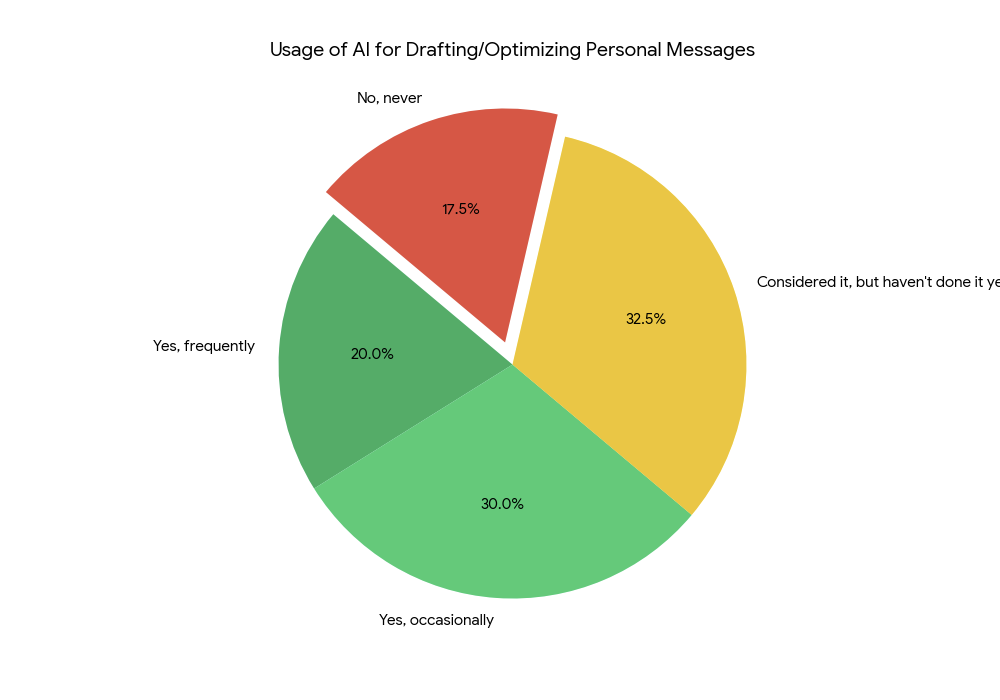
Currently, already 50% of HNWIs on Luxy use AI to draft, refine, or optimize their personal and professional messages, with an additional 32.5% having considered the technology but not yet implemented it. This indicates a general 82.5% total market openness toward AI-assisted communication.
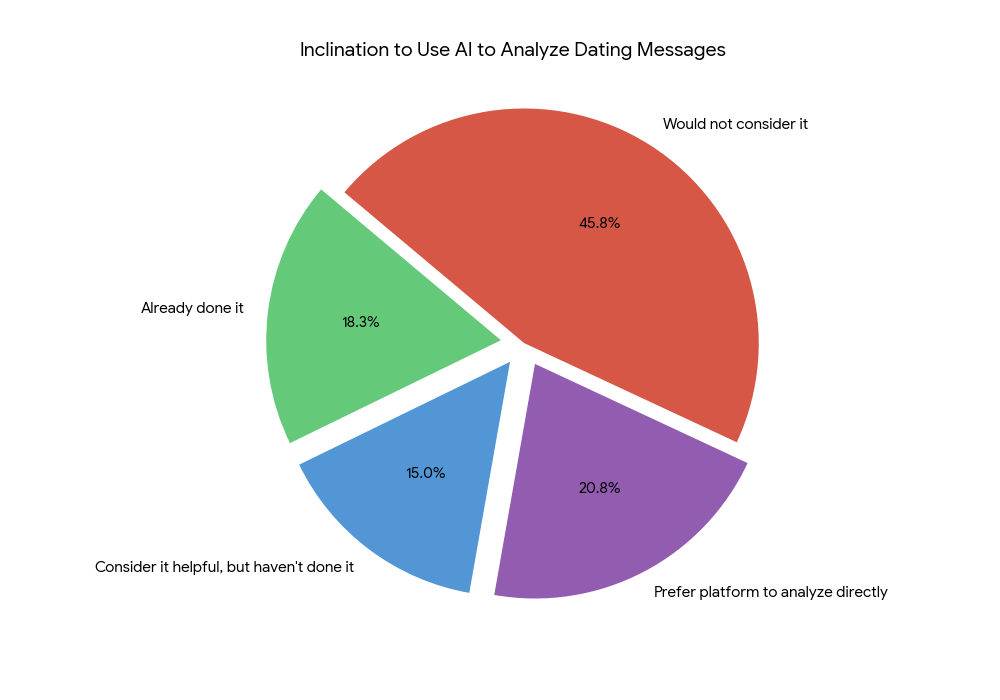
However, the role of AI is shifting from active generation (writing) to passive auditing (analysis). When presented with the prospect of feeding messages from potential matches into an AI to analyze tone and intention, 54.2% of HNWIs expressed openness to the idea. Within this group, a proactive 18.3% have already utilized AI for this purpose, while 20.8% specifically indicated a preference for the dating platform to provide this analysis directly. This suggests that for the elite user, the Emotional Auditor is most trusted when it is an integrated, seamless feature of the ecosystem rather than a third-party tool.
Specialized Detection Scenarios: What HNWIs Want to Know
The demand for AI auditing is driven by specific anxieties unique to the HNWI experience. The interest in "Emotional Auditing" is not generalized; it is targeted toward identifying specific threats that traditional vetting fails to catch.
1. Identifying Red Flags and Inconsistencies
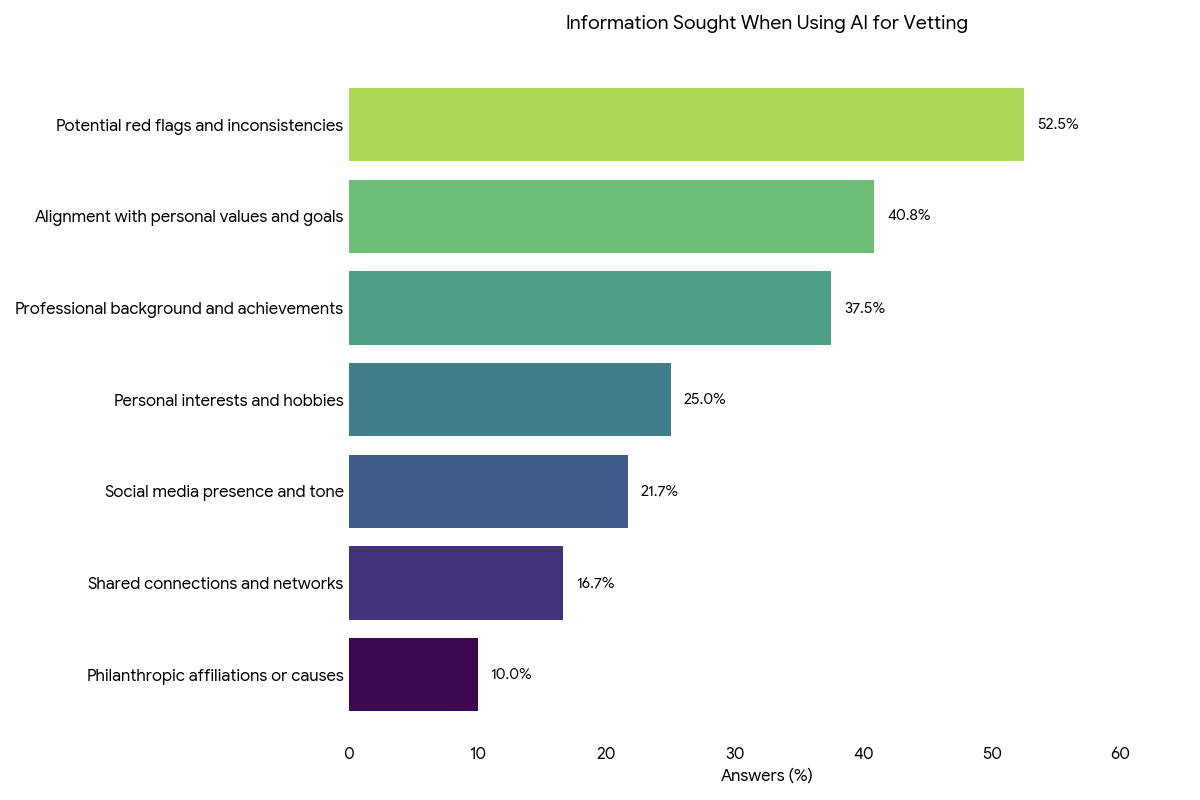
The primary driver for AI vetting is the detection of deception. 52.5% of HNWIs prioritize the identification of "red flags and inconsistencies" above all other data points. In the context of an "Emotional Auditor," this translates to an interest in AI’s ability to flag "Love Bombing" or coercive language patterns. By analyzing the velocity of emotional escalation, the AI can alert the user when a match’s rhetoric deviates from healthy social norms, providing an objective counter-narrative to intense, potentially manipulative affection.
2. Financial and Professional Scrutiny
The "gold-digger" trope remains a grounded reality for the wealthy. 55% of respondents identified financial risk as their primary concern when meeting new people online, and 37.5% specifically seek AI assistance in vetting a partner's professional background and achievements. An Emotional Auditor serves as a filter for "lifestyle probing"—identifying when a match’s questions focus disproportionately on assets, liquidity, or professional status rather than personal compatibility.
3. Reputational Guardrails and Over-Disclosure
For individuals whose names are tied to corporations or philanthropic foundations, a lapse in judgment during a private conversation can have public consequences. 35% of HNWIs are concerned about reputational risk, and 29.2% fear the personal impact of embarrassment or social fallout. There is a burgeoning interest in AI that can act as a "reputational coach," flagging when a conversation might be leading toward the over-disclosure of sensitive information that could later be used for blackmail or social engineering.
The Contextual Divide: Business vs. Romance
A notable psychological barrier remains regarding the "romance" of AI. Currently, 44.2% of HNWIs find the use of AI more acceptable in a business context than in dating, while 29.2% believe the perception is the same across both fields. Only a small minority (4.2%) finds it more acceptable in dating.
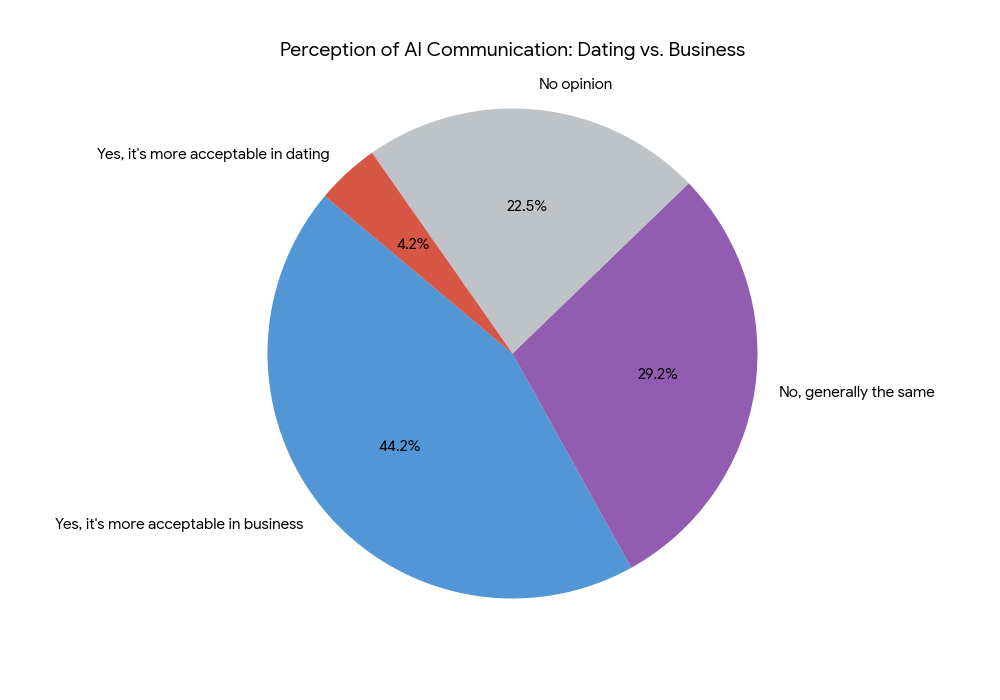
This discrepancy highlights a "Sincerity Paradox": HNWIs want the protection of AI, but they fear that using it themselves might make them appear insincere. This is reflected in how they choose to deploy the technology. A dominant 68.3% of HNWIs state they would primarily use their own sentences, using AI only strategically to formulate or refine thoughts. Only 5.8% would directly send AI-generated messages. This suggests that the "Emotional Auditor" should not replace the user’s voice, but rather act as a "co-pilot"—providing a layer of strategic analysis and risk detection while allowing the user to maintain the "human touch" that is essential for genuine connection.
Real-Time vs. Strategic Analysis
The preference for how this information is delivered is shifting toward real-time protection. While HNWIs are cautious about the "authenticity" of AI-generated text, they are highly receptive to AI-generated insights. The data indicates that the elite user views AI as a sophisticated filter. They are less interested in an AI that speaks for them and more interested in an AI that listens for them.
By focusing on "potential red flags" (a priority for 52.5%) and "alignment with personal values" (40.8%), the Emotional Auditor serves a dual purpose: it is both a shield against the predatory and a compass for the compatible.
In conclusion, the HNWI community is ready for AI to enter the social sphere, provided it functions as a guardian of their interests rather than a replacement for their personality. The "Emotional Auditor" is perceived as a tool for risk mitigation—addressing the 55% who fear financial loss and the 35% who fear reputational damage—by providing an objective, data-driven layer of scrutiny that human intuition, however refined, cannot achieve alone.
V. The Practicalities of an AI Emotional Firewall
The transition from a theoretical Emotional Firewall to a functional feature online leaves much room for speculation. But in general, such practical application needs to must function as a background auditor, balancing security with a helpful, proactive service typical of a private concierge.
1. How This AI Auditor Can Look Like
The primary architecture of an AI assistant is built upon its analytical capabilities that operate simultaneously to provide a robust defense against manipulation:
- Sentiment Tracking: Real-time analysis of the emotional temperature to identify shifts from genuine interest to high-pressure tactics.
- Pattern Recognition: Detection of linguistic fingerprints associated with known bad actors or premature financial inquiries.
- Anomaly Detection: Monitoring for deviations from standard HNWI interaction baselines, such as erratic response patterns or attempts to move to unencrypted platforms.
For e.g. users on Luxy, the delivery of information is as critical as the data itself. The system should be presented as a separate feature, accessible for every single match and not generalized:
- Nudges: When texting, adding extra signals when need for caution without interrupting the flow.
- Actionable Insights: Providing specific context and more information, such as identifying rapid emotional escalation. Not simply blocking people.
- Post-Interaction Summaries: Highlighting underlying dynamics, such as one-sided emotional labor or dominating narratives.
- Customizable Thresholds: Allowing people to set their own sensitivity levels for different preferences, ensuring the AI acts as a tailored consultant.
2. Navigating the Authenticity Paradox
The implementation of such a tool must be reconciled with the user’s desire for genuine connection, a tension clearly reflected in current community sentiment. When considering the role of AI in personal interactions, there is a distinct boundary that HNWIs are unwilling to cross. Approximately 34% of users view the idea of a perfectly mimicked AI managing their initial interactions as fundamentally inauthentic, while 29% prefer to handle all communications personally from the very first message. This resistance is further highlighted by the fact that only 19% of the community would delegate initial screening to an automated surrogate, and a mere 18% would trust an AI to handle compatibility checks.
However, a clear distinction exists between automation and assistance. While users largely reject the idea of an AI "mimicking" their personality, there is a massive appetite for strategic guidance. Approximately 73% of respondents indicated they would utilize an AI as a strategic assistant for help and guidance, compared to only 27% who would decline such support. This suggests that for the Emotional Firewall to be successful, it must be positioned as a "wingman" or consultant that clears the path for authenticity by removing predators and noise, rather than a tool that attempts to fabricate the connection itself.
3. Ethics, Privacy, and the Calibration of Trust
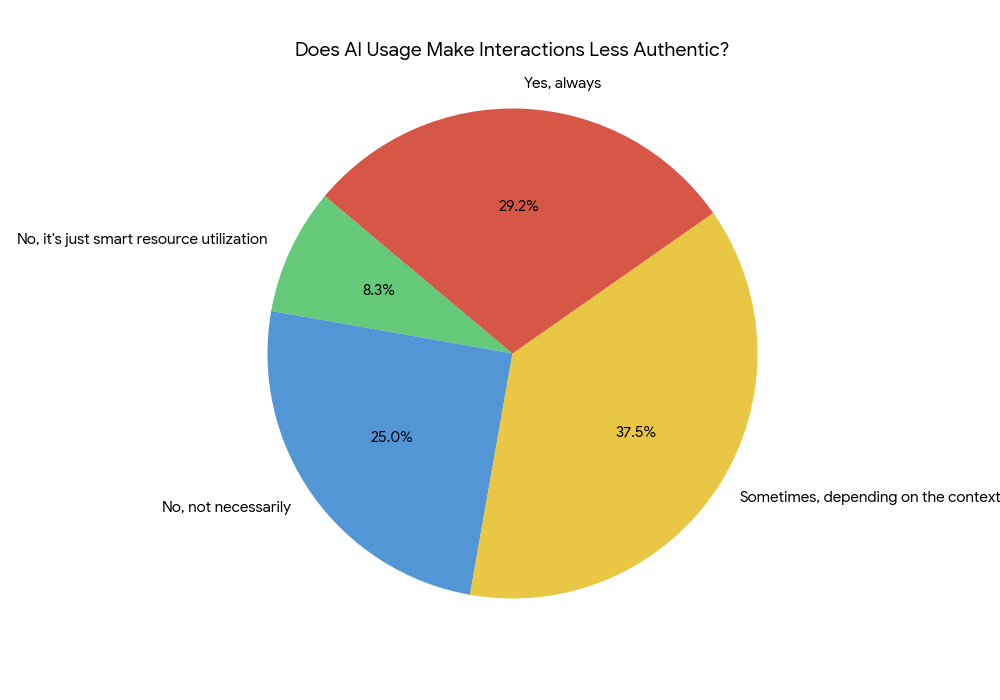
The final hurdle in deploying an AI Auditor lies in the inherent difficulty of interpreting human complexity and the high value HNWIs place on privacy. The Luxy community remains divided on the morality of AI intervention: while 25% believe that using AI assistance isn't necessarily inauthentic and 8% see it as a smart utilization of available resources, a combined 67% of the community harbors concerns, viewing it as either "sometimes" or "always" less authentic. This high level of skepticism necessitates a transparent approach to data handling, where the AI operates within a localized, encrypted framework that ensures personal data is never used for platform-side mining.
To bridge this trust gap, the system must account for cultural nuance and individual preference. AI often struggles with sarcasm or high-context communication styles: a direct request for what someone brings to the table might be flagged as a red flag in one culture but viewed as a pragmatic necessity in another. Consequently, this Firewall must allow for personal customization and input. Trust is built when the AI accurately identifies a risk that the user had a gut feeling about but could not quite articulate.
VI. AI as an Emotional Intelligence Coach
The true potential of AI within the Luxy ecosystem lies in its transition from a protective shield to a pedagogical tool. HNWIs, show a clear trend: They do not merely want to be protected but empowered with the emotional intelligence to make better and more informed decisions on their dating journey themselves.
The survey results indicate a resounding mandate for EQ-focused AI, with approximately 84% of respondents expressing interest in an AI coach. Crucially, a significant portion of the community noted that it is more acceptable for an AI to coach and train the user privately than to interfere directly in communication. This highlights a preference for "social sparring" that sharpens personal instincts while preserving the user’s authenticity and agency.
1. Core Competencies: Red Flags and Communication
When identifying specific areas for development, the community prioritized risk assessment and interpersonal strategy:
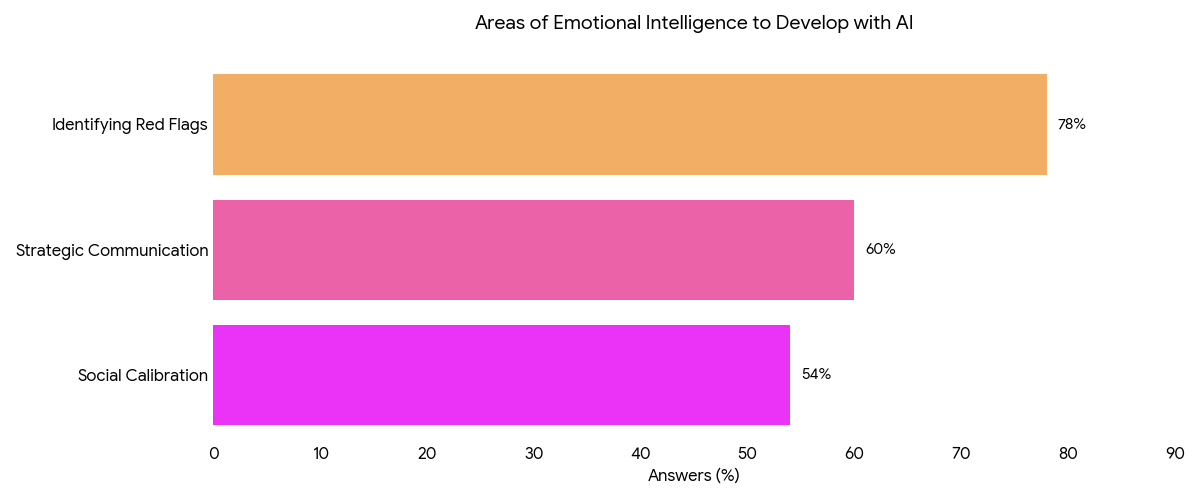
- Identifying Red Flags (78%): The primary demand is for an AI that explains the "why" behind concerning patterns, teaching users to spot inconsistencies independently.
- Strategic Communication (60%): Users seek feedback on their own tone, clarity, and empathy to ensure their digital presence aligns with their intentions.
- Social Calibration (54%): Over half of respondents want guidance on "social radar"—knowing when to pursue a topic, when to retreat, and how to better understand the emotional states or motivations of others. This includes practical advice on setting boundaries effectively without stifling connection.
2. Vetting for Value Alignment
The data regarding vetting preferences reinforces that HNWIs are looking beyond superficial metrics. While identifying potential red flags remains the priority (52.5%), the focus has shifted toward deeper compatibility:
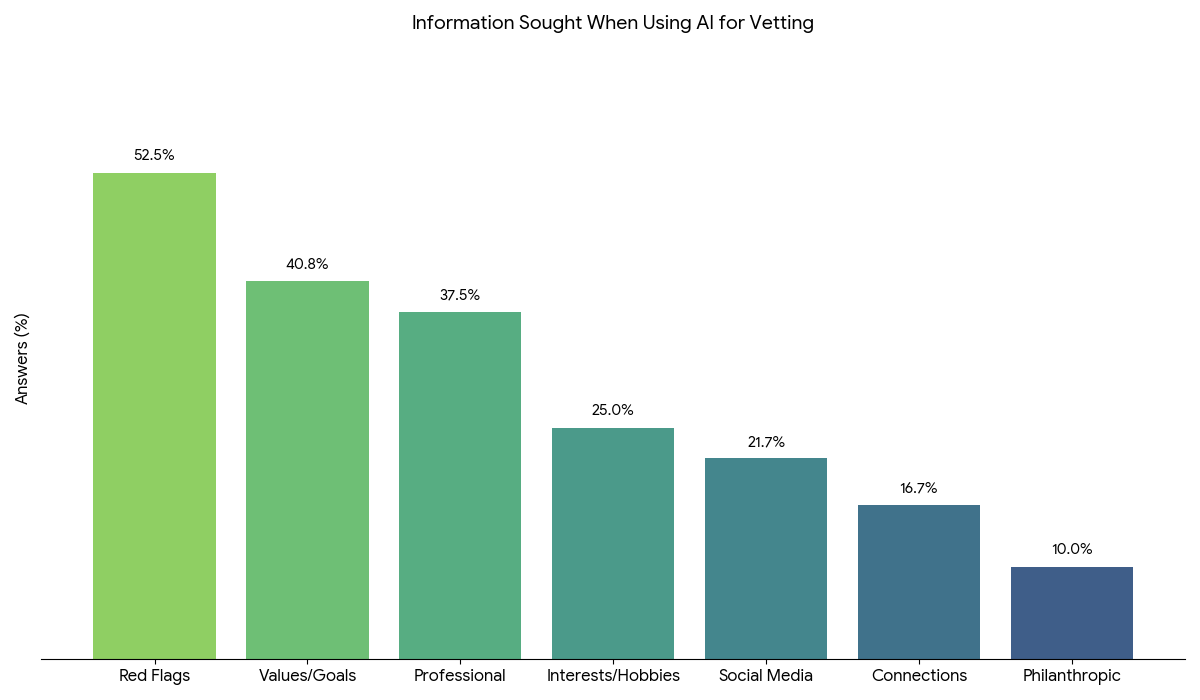
- Alignment with Personal Values (40.8%): This ranked higher than traditional status markers.
- Professional Background (37.5%) and Personal Interests (25%): These remain baseline requirements for the demographic.
- Social Media Tone and Presence (21.7%): Users are increasingly interested in how a prospect’s digital footprint reflects their character.
- Shared networks (16.7%) and philanthropic affiliations (10%) were seen as less critical than behavioral consistency.
3. The AI as a Strategic Asset
By focusing on coaching rather than just filtering, the AI becomes a long-term asset. It transforms the dating experience from a series of risks into a journey of personal growth. Instead of creating a dependency, the system acts as emotional scaffolding—helping users communicate boundaries and interpret motivations, eventually leading to more successful, authentic, and self-managed relationships.
VII. Implications for Luxy & the Future of Online Dating
The integration of AI systems within the Luxy ecosystem would mark a paradigm shift from traditional online dating to an Intelligent Relationship Management. The focus should remain on the delicate balance between technological efficiency and the human touch that defines the elite experience.
1. Ethical Considerations & Trust Building
For HNWIs, trust is one of the most important considerations. The implementation of AI must be governed by a framework of radical transparency and user agency.
- Transparency and Disclosure: Luxy must maintain an "Open Box" policy regarding its algorithms. Users should be clearly informed when they are interacting with an AI coach or when an automated system has flagged a potential risk. Providing the "reasoning" behind AI suggestions—such as citing specific behavioral patterns—prevents the technology from feeling like a "black box" and builds cognitive trust.
- User Sovereignty and Control: AI features should be modular and opt-in. Whether it is the "EQ Coach" or the "Automated Vetting" suite, users must retain the power to toggle these features based on their comfort level. Furthermore, data privacy must exceed industry standards, ensuring that the analysis of communication patterns is used solely for the user’s benefit and never monetized or shared.
- The Human-in-the-Loop (HITL) Model: AI is a supplement, not a replacement, for human judgment. Luxy should maintain a tier of human moderators and relationship experts who oversee high-level disputes or complex vetting scenarios. This ensures that the "Elite" status of the platform is maintained by human standards of excellence, supported by machine precision.
2. Strategic Outlook: Emerging Horizons
The future of elite dating will likely see the expansion of AI into even more immersive and protective territories:
- Biometric Verification & Deepfake Defense: As synthetic media becomes more sophisticated, Luxy will lead in implementing cryptographic identity verification to ensure that every profile is 100% authentic.
- Virtual "Safe-Space" Simulations: Using AI to create low-stakes virtual environments where users can practice social interactions or "meet" in a secure, simulated high-end venue before transitioning to physical reality.
- Long-term Compatibility Analytics: Shifting the focus from "the first date" to "long-term alignment" by analyzing shared values and life goals through deeper, AI-assisted discovery phases.
By adopting these technologies, Luxy can position itself not just as a dating app, but as a pioneer in Intelligent Social Safety. While competitors focus on volume and gamification, Luxy’s trajectory is toward a real but selective dating approach.
- Predictive Safety: Moving from reactive blocking to proactive prevention using sentiment analysis and behavioral forecasting.
- Global Standards for Elite Digital Conduct: Luxy has the opportunity to set the standard for how high-status individuals interact online, creating a digital environment where the barrier to entry is not just wealth, but character and emotional intelligence.
The evolution of Luxy represents a commitment to the idea that technology should make us more human, not less. By leveraging AI to filter out the noise of deception and the friction of social anxiety, we are clearing the path for what truly matters: authentic, high-value human connection.
The future of elite dating is one where security is invisible but absolute, and where intelligence serves as the foundation for lasting relationships. Luxy is elevating the standard of how they connect, ensuring that every interaction is as secure as it is significant.