How HNWIs Use AI To Connect Better On Dating Apps

Executive Summary
This report explores the sophisticated integration of Artificial Intelligence within the lifestyles of HNWIs, specifically focusing on its role as a strategic lever in high-stakes social and professional communication. As the digital landscape evolves, the elite are moving beyond using AI for simple efficiency, instead adopting it as a critical tool for risk management, strategic rehearsal, and social intelligence.
Core Objectives
- Strategic Leverage: To investigate how HNWIs utilize AI to optimize messaging, rehearse complex interactions, and identify strategic opportunities.
- The Authenticity Balance: To analyze the tension between the demand for genuine human connection and the strategic advantages provided by AI.
- Social Discernment: To uncover perceptions regarding the "AI Trace" and how the ability to detect automated content is becoming a new marker of social status.
Key Findings
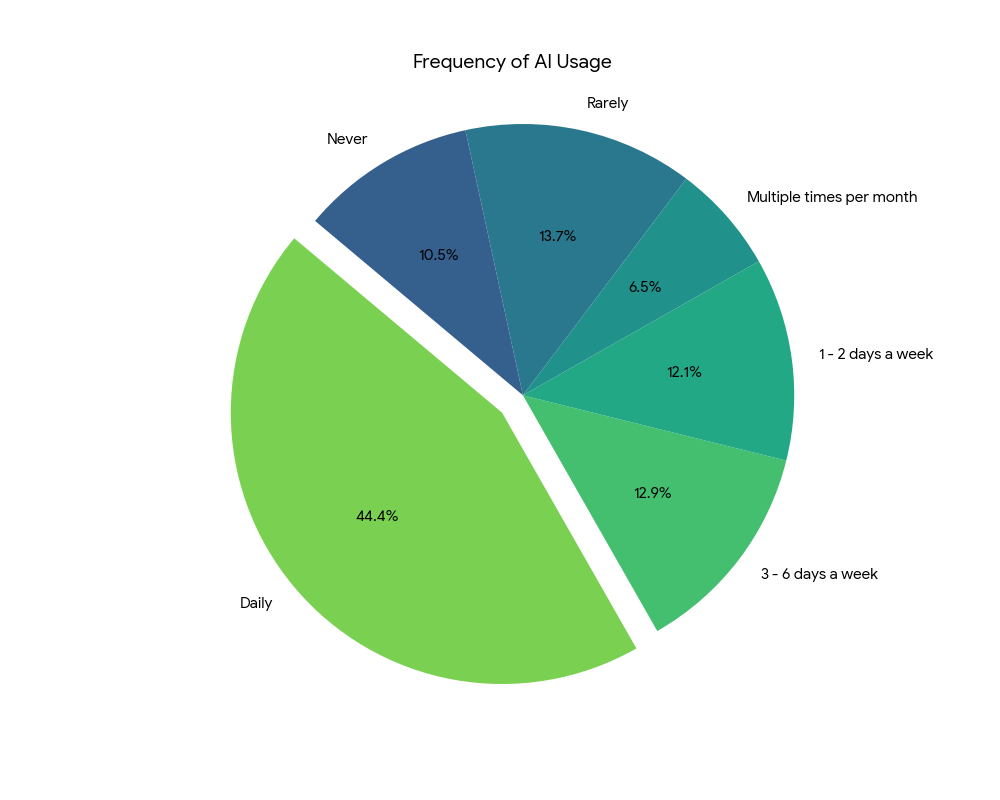
- Normalization of AI Strategy: AI has become a daily staple for the elite, with 44.4% of HNWIs reporting daily use. Over 70% of the demographic uses AI at least once a week, primarily for drafting and refining messages to ensure maximum diplomatic and social impact.
- Demand for Proactive Vetting: There is a significant latent demand for AI-driven social intelligence. While currently a developing habit, 52.5% of respondents prioritize using AI to identify red flags and inconsistencies in potential contacts, viewing it as a necessary defense against reputational risk.
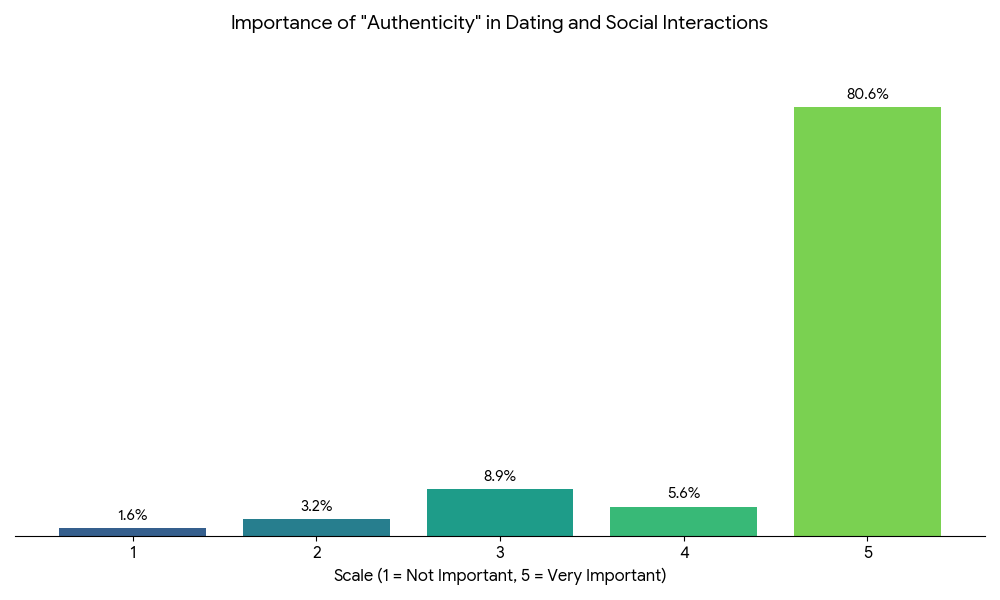
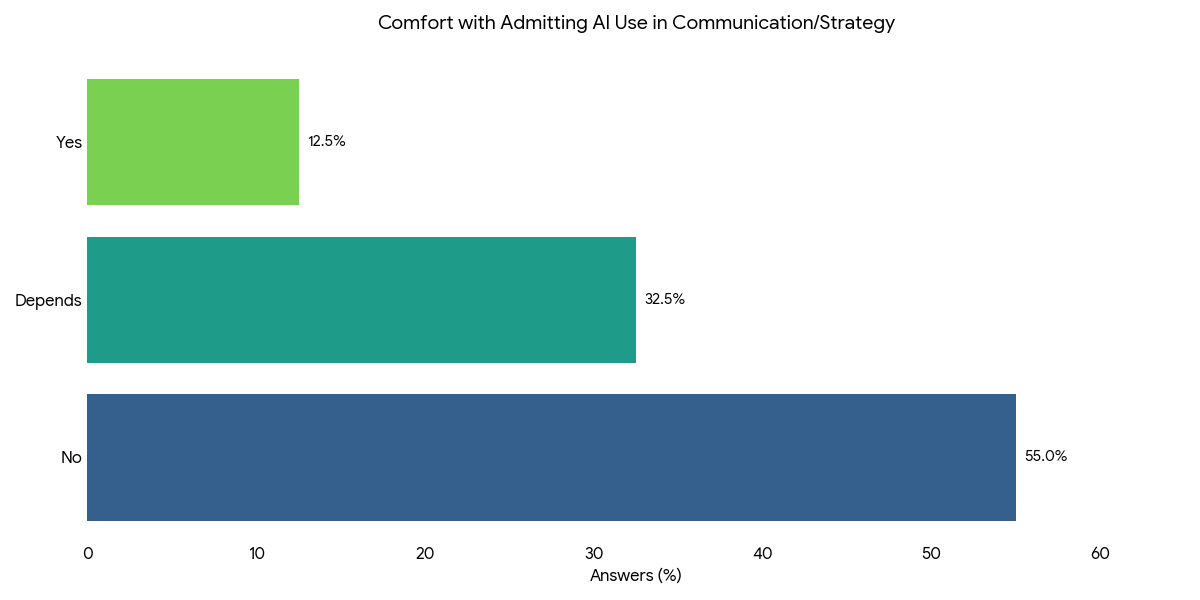
- The Authenticity Paradox: While 80.6% of HNWIs rank authenticity as their highest priority, a significant portion uses AI as a silent partner. Most users (55%) are uncomfortable disclosing their use of AI, preferring to maintain an illusion of effortless charisma rather than admitting to technological assistance.
- Detection as a Status Signal: A new hierarchy of social intelligence is emerging. Over 53% of HNWIs are confident in their ability to detect AI-generated content. Identifying an "AI Trace" is increasingly viewed as a valuable skill, with 48.4% of users stating that detecting automation makes them lose interest in a contact immediately.
- From Automation to Augmentation: HNWIs reject "lazy" AI that replaces the human voice. Instead, there is an overwhelming preference for AI as a "Strategic Assistant”, a tool that helps refine thoughts and identify connections without crossing the line into inauthentic, mass-market automation.
The future of elite socializing lies in the seamless blend of human intuition and algorithmic insight. As HNWIs continue to navigate increasingly complex global networks, the platforms that succeed will be those that offer "high-intelligence" augmentation rather than "low-effort" automation. By championing a standard of assisted authenticity, we are entering an era where technology does not replace the individual, but rather sharpens the precision of every connection made at the top of the social pyramid.
1. Introduction: The Evolving Role of AI in HNWIs Lifestyles
HNWIs operate in an environment defined by high time costs and extreme reputational sensitivity. In this sphere, every interaction, whether a high-stakes business introduction or a first date, is viewed through the lens of strategic importance. Because personal reputation is often a primary asset, the margin for error in communication is remarkably thin.
The Shift from Efficiency to Strategy
Traditionally, the role of AI in daily life was limited to basic efficiency. It served as a tool for scheduling, spellchecking, or generating surface-level content. However, we are witnessing a fundamental shift in how the elite interact with these technologies. AI has evolved from a simple administrative assistant into a sophisticated sandbox for strategic rehearsal and social intelligence.
This transformation marks the move from using technology to save time toward using technology to improve the quality of outcomes.
The Unique Needs of the Elite
A common misconception is that users turn to AI because they lack the words to express themselves. For the HNWI demographic, the opposite is true. These individuals do not use AI because they do not know what to say; they use it to ensure that what they say achieves a specific, optimized result.
In complex social and professional landscapes, AI is leveraged as a risk-management tool. It allows users to:
- Manage Risks: Stress-testing a response before it is sent to ensure it cannot be misinterpreted.
- Identify Opportunities: Analyzing social dynamics to find hidden synergies or common ground.
- Optimize Impact: Calibrating tone and delivery to match the high expectations of their peer group.
For the modern strategist, AI is not a replacement for human connection, but a silent partner in navigating the complexities of high-value socializing.
2. AI as a Strategic Rehearsal & Sandbox
For HNWIs, there’s a side effect when taking a look at communication that is rarely talked about: the exercise in reputation management and risk mitigation. Our survey results reveal a significant shift in how Luxy users view Generative AI. It is no longer just a tool for automation, but a "sandbox" where high-stakes interactions are stress-tested before they ever reach the intended recipient.
2.1 The High-Frequency Elite: Normalizing AI Integration
The data suggests that AI has already become a staple in the daily lives of Luxy users. A commanding 44.4% of HNWIs on Luxy report using AI tools, ranging from LLMs like ChatGPT and Gemini to creative generators, on a daily basis. When expanded to those using it at least once a week, the adoption rate climbs to nearly 70%. This high frequency suggests that AI is being woven into the fabric of their decision-making processes rather than being reserved for isolated technical tasks.
Precision Messaging: Beyond "What to Say"
In elite circles, the nuance of a message can be the difference between a successful partnership and a total loss of rapport.
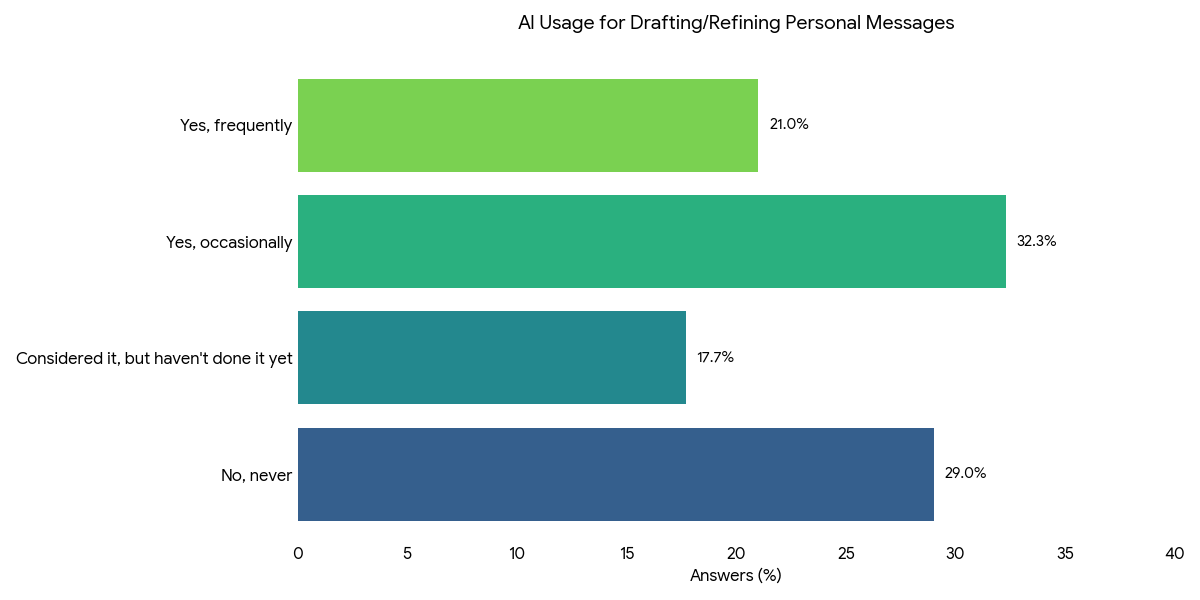
- 53.3% of respondents currently use AI to draft, refine, or optimize their personal and professional messages (“yes, frequently” and “occasionally” combined).
- An additional 17.7% have considered it, suggesting that nearly 3/4 of the HNWIs on Luxy recognize the value of AI-assisted linguistic precision.
For these users, the objective isn't to replace their voice, but to calibrate it. They leverage AI to ensure their tone aligns perfectly with their intent, removing emotional "noise" or enhancing diplomatic subtext in both social and business landscapes.
The Analytical Edge: Decoding the Other Side
Perhaps the most "strategic" application of AI identified in the survey is its use as a social intelligence decoder. Rather than just generating their own content, HNWIs are beginning to use AI to analyze the content they receive.
When asked about feeding messages from matches or social contacts into an AI to analyze tone and hidden intentions:
- 18.3% have already adopted this "reconnaissance" approach.
- 15% view it as a helpful strategy they intend to use.
- Notably, 20.8% expressed a preference for the dating platform itself to provide these analytical insights directly.
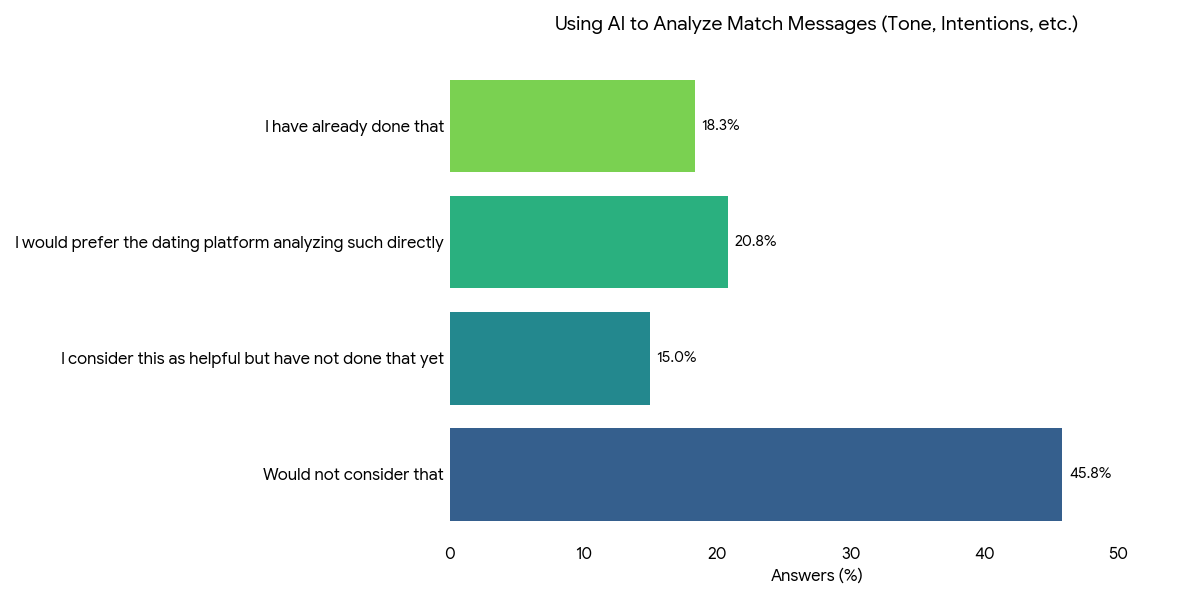
This indicates a growing demand for "Integrated Social Intelligence”, where the platform doesn't just facilitate the connection, but helps the user interpret the underlying dynamics of the interaction.
2.2 Conflict Resolution & High-Stakes Rehearsal
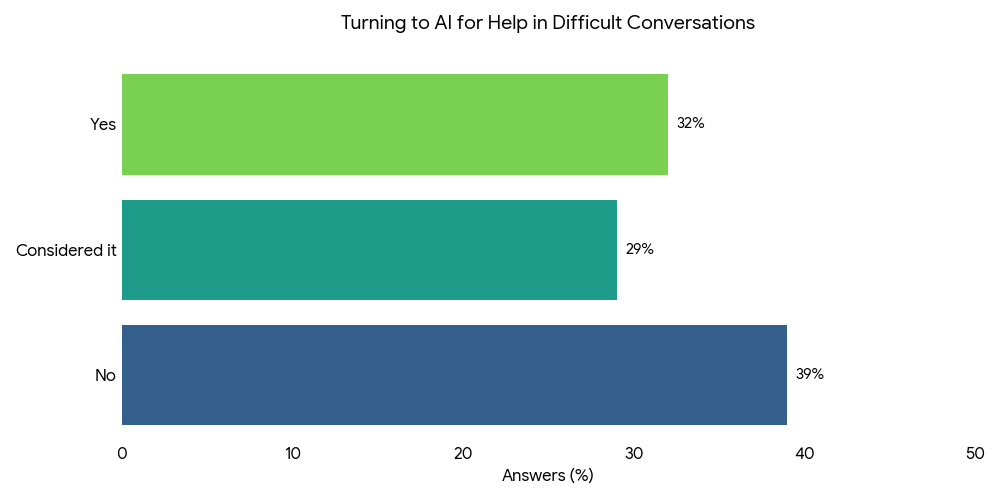
The survey highlights a pivot toward using AI for emotional and strategic de-escalation. Over 61% of HNWIs have either used or considered using AI to rehearse difficult conversations with family members, business partners, or dating prospects.
Key Rehearsal Metrics
Among those who use AI for rehearsal, over 60% focus on finding optimal phrasing and identifying common ground. This reinforces the idea that HNWIs are not looking for "canned" responses, but are using the AI as a sparring partner to anticipate counter-arguments and refine their own delivery to ensure a favorable outcome.
The Contextual Paradox: Business vs. Romance
Despite the high adoption rate in dating contexts, a clear "acceptability gap" remains.
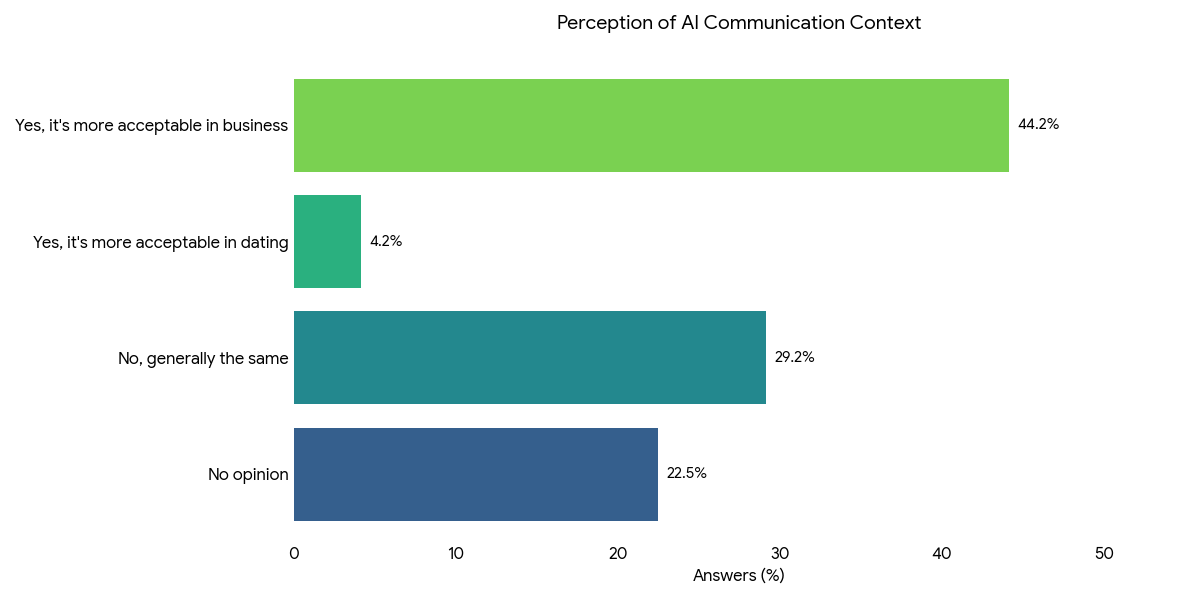
- 44.2% of respondents believe using AI for communication is more acceptable in a business context.
- Only 4.2% feel it is more acceptable in a dating context.
- 29.2% see the perception as being identical across both spheres.
This suggests that while HNWIs are strategically leveraging AI in their romantic lives, they remain acutely aware of the "authenticity tax" associated with it. They are using the tool to gain an advantage, while simultaneously navigating a social landscape where the appearance of effortless, unassisted charisma is still the ultimate status symbol.
3. Proactive Social Vetting & Opportunity Identification
For high-net-worth individuals, the boundary between a romantic connection and a strategic alliance is often fluid. The report indicates a transition from traditional background checks toward a more comprehensive, AI-driven form of social intelligence. This involves analyzing public footprints, ranging from professional achievements on LinkedIn to social media sentiment and public records, to build a multi-dimensional profile of a potential contact.
The Vetting Hesitation: A Market in Waiting
While the concept of using AI for proactive vetting is high, there is a clear gap between interest and implementation.
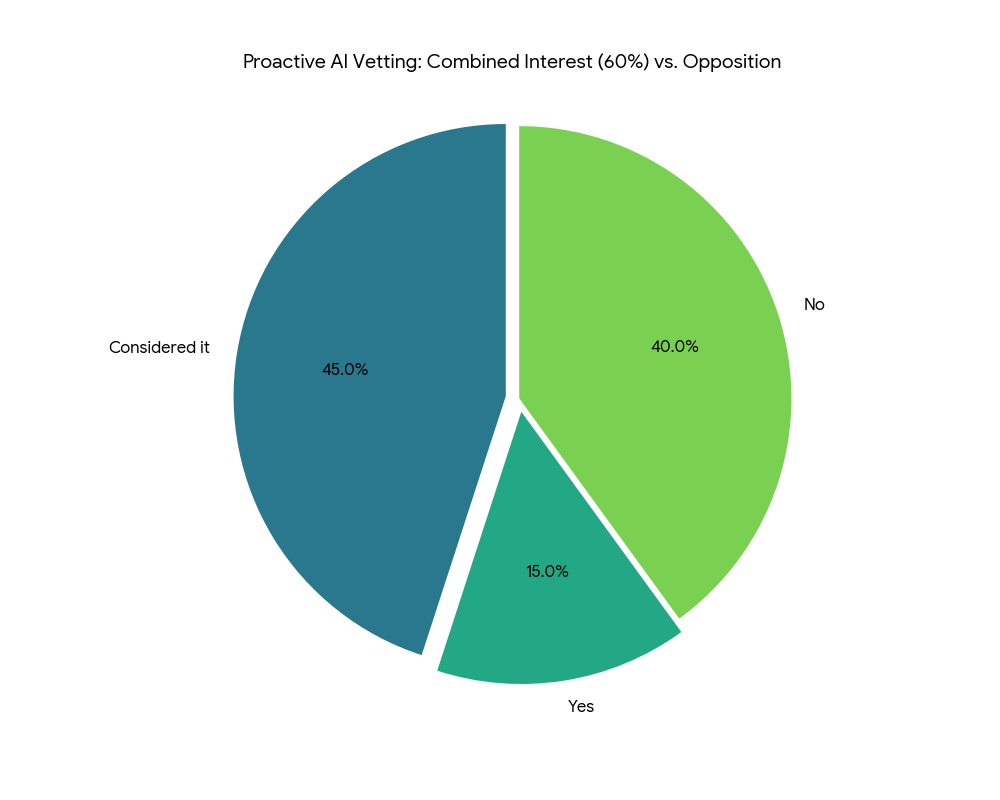
Currently, only 15% of respondents have actively used AI to research or vet individuals beyond basic checks. However, 45% of the group has considered doing so, while 40% remain disinterested. This suggests a significant segment of the elite population is curious about the technology but perhaps lacks the specific tools or ethical framework to begin. The high percentage of those considering it reveals a latent demand for sophisticated, integrated vetting features that go beyond simple data scraping.
Priority One: Risk Mitigation and Value Alignment
When HNWIs look at an AI-enabled vetting process, their primary motivation is not just finding a match, but identifying potential friction. The data shows that 52.5% of users prioritize the detection of red flags and inconsistencies above all else. In a world of high stakes and public reputations, the ability to preemptively spot a discrepancy in a narrative is a critical defensive maneuver.
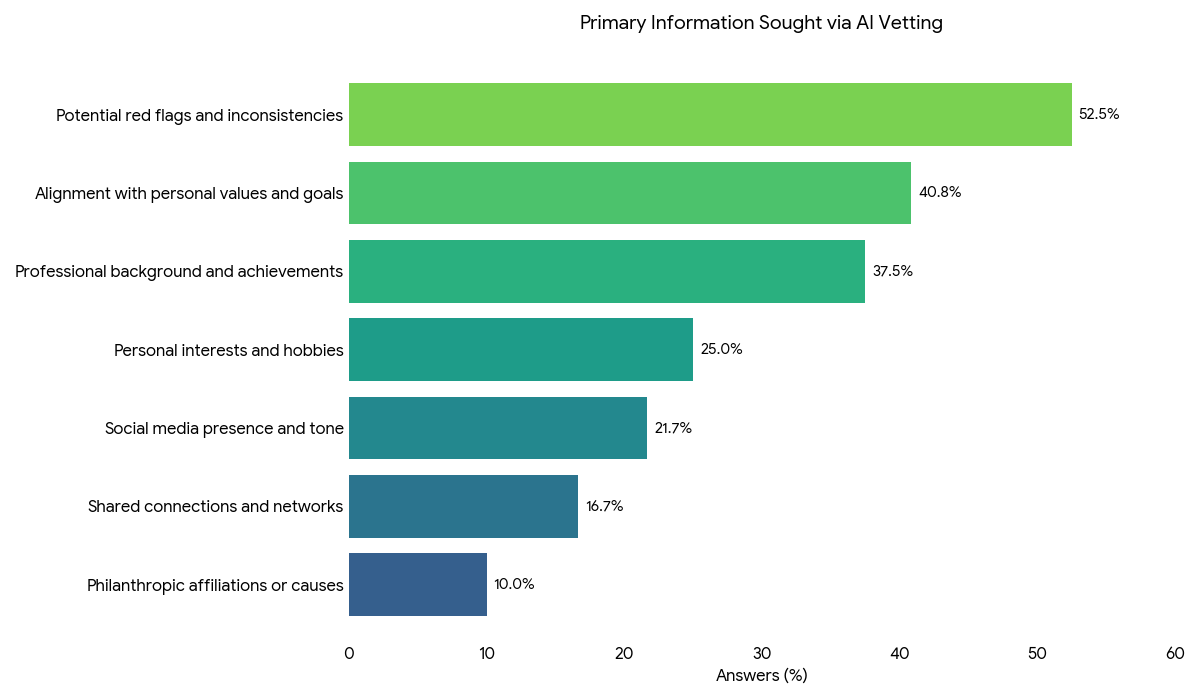
This hierarchy indicates that for the elite, a partner or contact is evaluated first on their integrity and vision, and only secondarily on their leisure activities.
From Networking to Opportunity Mapping
The report highlights a growing interest in using social circles for broader strategic gain. While only 10% specifically look for philanthropic affiliations during initial vetting, there is an overwhelming consensus on the potential for AI to act as an opportunity assistant.
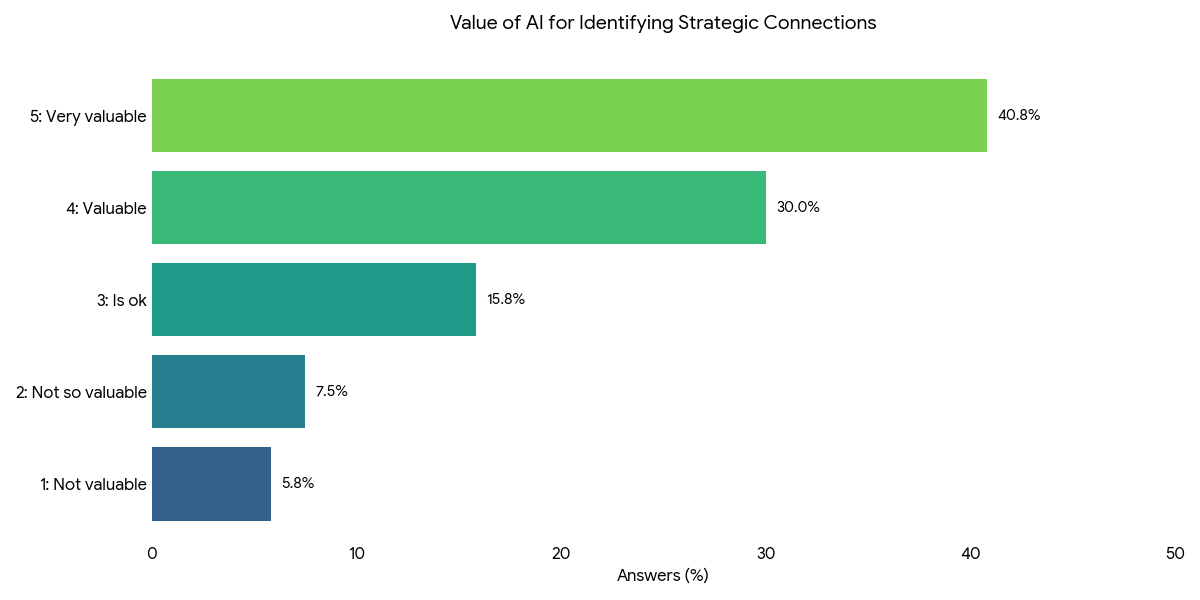
When asked about the value of an AI tool designed to identify strategic connections or business opportunities within their social network, the response was decisively positive. 40.8% rated such a tool as very valuable, and 30% rated it as valuable. Combined, over 70% of the HNWI demographic sees the utility in a platform that doesn't just find a date, but maps out potential for business collaborations, philanthropic partnerships, or shared networks.
This shifts the role of a platform like Luxy from a simple matchmaking service to a high-level social intelligence dashboard. Users are signaling that they want an assistant capable of identifying the silent synergies between their personal and professional worlds.
4. The Authenticity Question: AI, Strategy, and Elite Perceptions
The integration of AI into the private lives of HNWIs creates a fundamental paradox. While these individuals are often the first to adopt cutting-edge tools for efficiency, they simultaneously operate in a social tier where raw authenticity is the most guarded and valued currency. This chapter explores the tension between using AI as a strategic lever and the potential social cost of being perceived as artificial.
4.1 The Authenticity Mandate
For the elite, authenticity is not a soft preference: it is a clear requirement for trust and long-term engagement.
The survey results are unequivocal: 80.6% of respondents rate the importance of authenticity in their dating and social interactions as a 5 out of 5. When including those who rated it a 4, the consensus reaches over 86%. This suggests that any tool which threatens to mask a user’s true persona faces a significant barrier to entry in high-stakes social circles.
The Sliding Scale of AI-Assisted Sincerity
The perception of whether AI diminishes authenticity is nuanced rather than binary. When asked if AI assistance makes an interaction less authentic:
- 29.2% feel it always compromises the integrity of the interaction.
- 37.5% believe it depends entirely on the context.
- 33.3% are more forgiving, viewing it either as a neutral tool or as smart resource utilization (both “no” response categories combined).
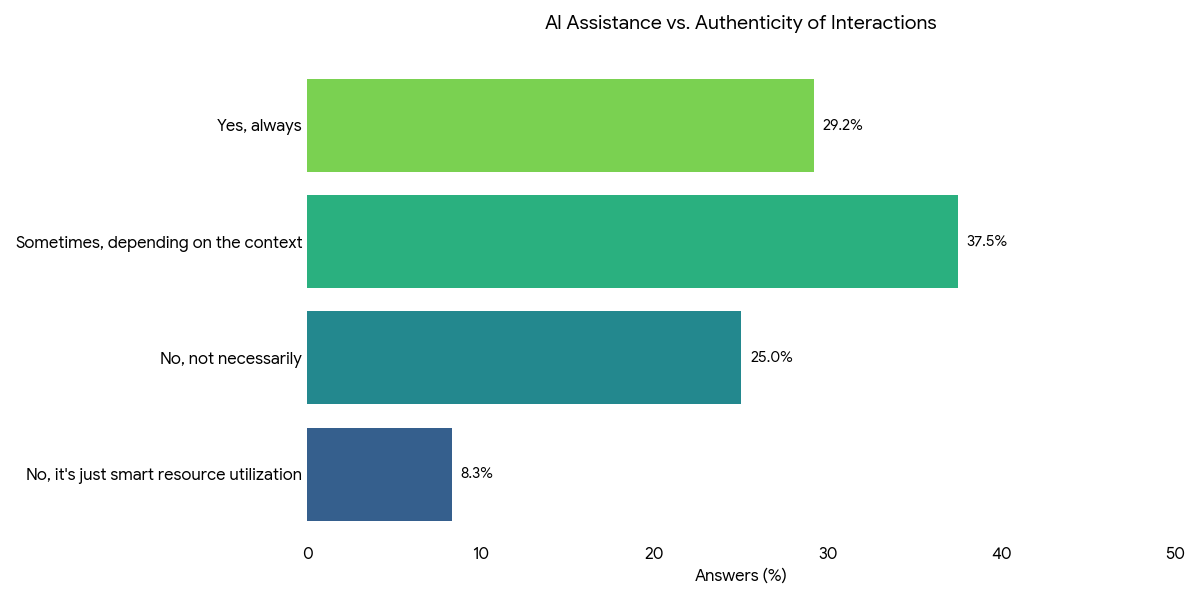
These figures indicate a dividing line in the HNWI community. One segment views AI as a form of intellectual enhancement, similar to hiring a speechwriter or a consultant, while nearly a third of the community views it as a deceptive layer that erodes the human element of a connection.
4.2 The Calculating Stigma: Why Users Hide the Tool
A significant social stigma remains attached to AI usage in personal spheres. When evaluating others who use AI for strategic communication, the descriptors chosen by respondents skew toward the negative:
- 54.2% describe such individuals as calculating.
- 33.3% use the more neutral term efficient.
- Only 12.5% view them as smart resource managers.
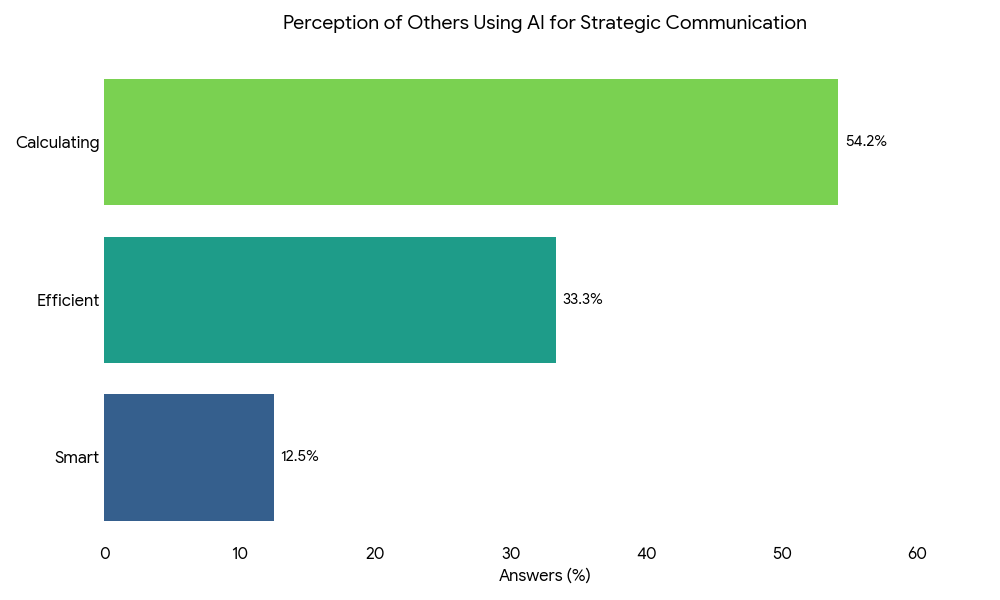
The label of being calculating is particularly damaging in a dating context, where the goal is often perceived to be emotional vulnerability and spontaneity. This negative perception directly influences user behavior regarding transparency.
A majority of 55% of respondents would flatly refuse to admit to a dating partner or social contact that they used AI to assist in their communication. Another 32.5% said it would depend on the situation, leaving a mere 12.5% who would be comfortable with full disclosure.
The Illusion of Effortlessness
The hesitation to admit to AI usage suggests that HNWIs still prioritize the illusion of effortlessness. In elite circles, the ability to be witty, charming, and strategically sound without visible assistance is a major status signal. Admitting to using an AI assistant breaks this spell, shifting the perception of the individual from naturally gifted to technologically dependent.
Consequently, AI is currently being used as a secret weapon, a silent partner that helps refine the output while the user retains 100% of the credit for the resulting charisma. The red line for most HNWIs is reached when the AI stops being a ghostwriter for their own thoughts and starts becoming a surrogate for their personality.
5. The AI Trace: Detection as a New Status Signal
In elite social circles, the ability to read between the lines has always been a primary indicator of sophistication. As artificial intelligence becomes a standard tool for the masses, a new form of social intelligence is emerging among HNWIs: the ability to identify the subtle markers of AI-generated content. This discernment is fast becoming a status signal, separating those who possess genuine interpersonal intuition from those who rely on automated shortcuts.
The Rise of the AI-Literate Critic
The survey data highlights a high level of confidence among the elite regarding their ability to spot non-human communication.
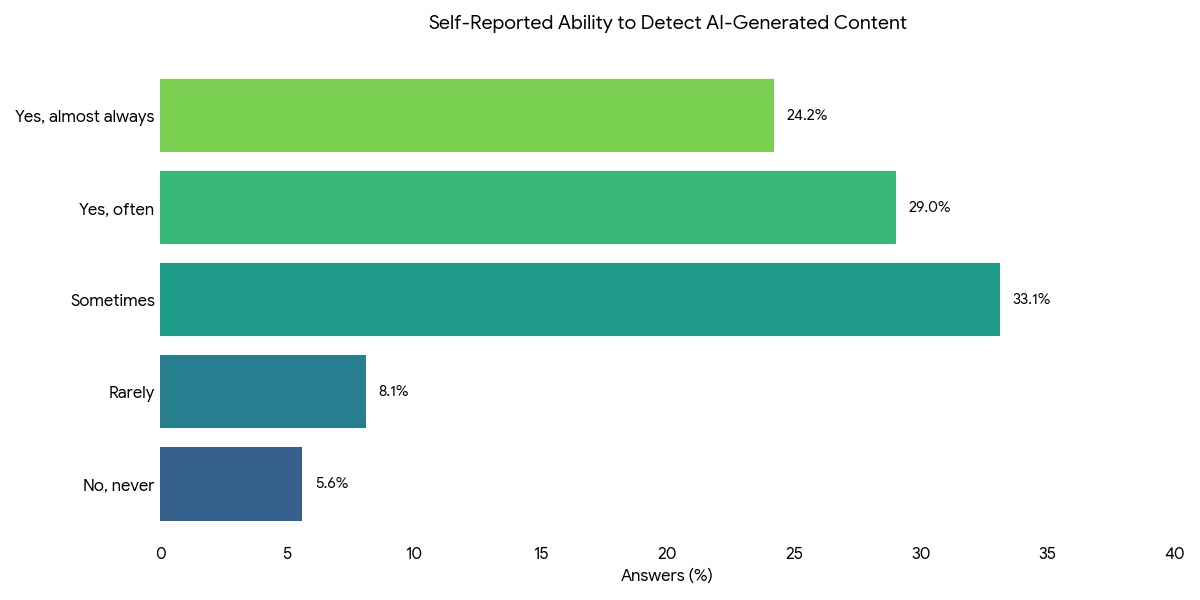
Over 53% of respondents believe they can detect AI-assisted messages almost always or often. When including those who can do so at least sometimes, the figure rises to over 86%. This suggests that the HNWI community is not a passive recipient of technology but an active, critical audience that is highly sensitive to the nuance of language.
Low Effort and the Trust Gap
The presence of an AI trace, a tell-tale phrase or a suspiciously polished structure, carries a heavy social penalty. For a demographic that values bespoke experiences and high-touch interactions, AI-generated content is often perceived as a signal of low effort.
The impact on interpersonal attraction and trust is significant:
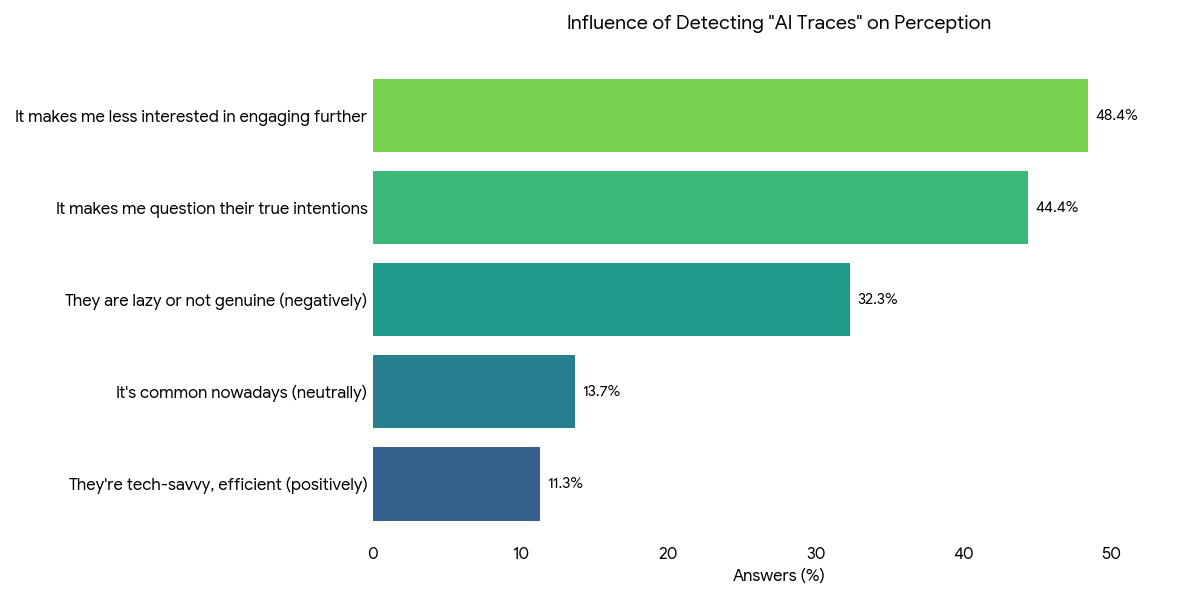
- 48.4% of respondents state that detecting AI traces makes them less interested in engaging further.
- 44.4% admit it causes them to question the true intentions of the sender.
- 32.3% view the use of AI as a sign of laziness or a lack of genuine effort.
While a small minority of 11.3% views AI usage as a positive sign of being tech-savvy, the overwhelming majority sees it as a red flag. In high-stakes dating and networking, where the goal is to establish a unique and authentic connection, using a generic algorithm to speak for oneself is increasingly viewed as a lack of investment in the relationship.
Discernment as a Sophisticated Skill
Perhaps the most telling finding is that the ability to detect AI is now viewed as a merit in its own right. Two-thirds of HNWIs consider the ability to identify AI-generated content to be either a valuable skill, a positive social signal, or both.
This creates a new social hierarchy. On one level, there are users leveraging AI to mask their deficiencies or save time. On a higher level, there are the observers who can see through the mask. This latter group views their discernment as a form of critical thinking and a testament to their understanding of modern tools. To be able to identify a bot-assisted message is the modern equivalent of being able to identify a vintage wine or a tailored suit: an exercise in identifying quality and effort.
6. The AI Blocklist: Identifying the Uncanny Valley
In the pursuit of perfect communication, many users fall into the trap of over-optimization. For HNWIs, certain linguistic patterns act as immediate deterrents, signaling a lack of personal investment. We present in this section the specific phrases and structures that comprise the AI Blocklist, language that feels engineered rather than evolved.
Luxy users frequently pointed to a specific brand of over-politeness and stiltedness that feels inauthentic. Words like swift, rapid, or exhilarate, while grammatically correct, often feel out of place in a contemporary social context and are perceived as markers of low-effort automation.
The AI Blocklist: Data Breakdown
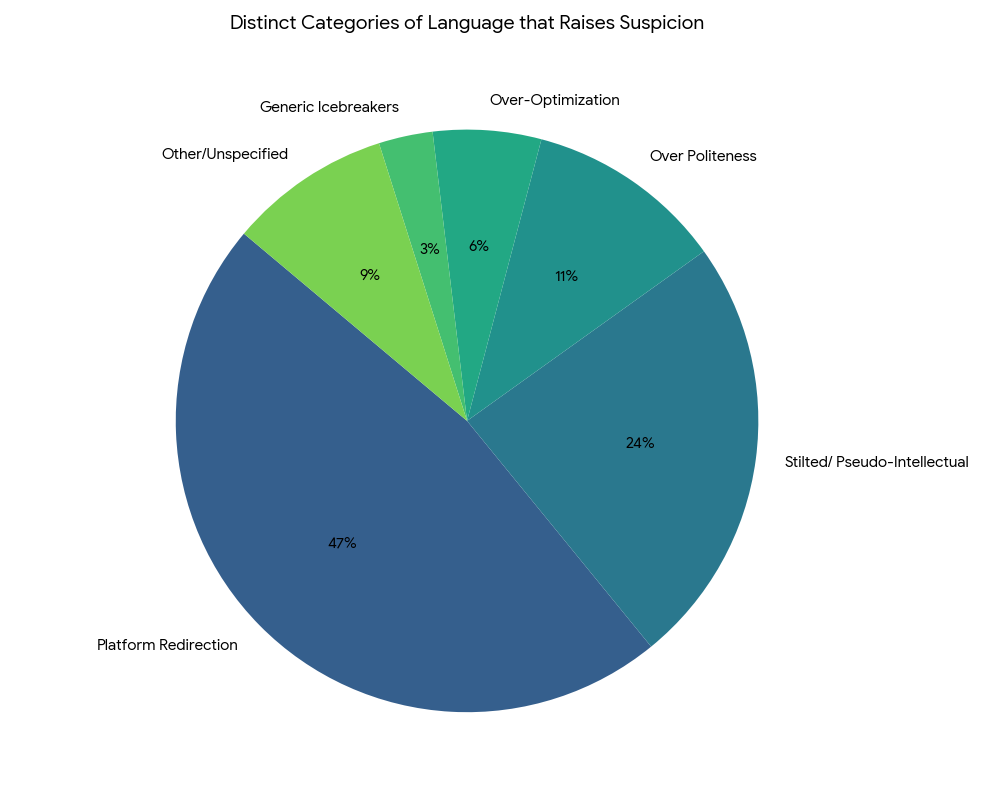
Analysis of user-reported phrases reveals five distinct categories of language that raises suspicion. These markers prompt nearly half of the HNWI community to disengage immediately.
Category | Frequency | Common Examples |
Platform Redirection | 47 % |
|
Stilted/ Pseudo-Intellectual | 24 % |
|
Over Politeness | 11 % |
|
Over-Optimization | 6 % |
|
Generic Icebreakers | 3 % |
|
The "Off-Platform" Red Flag
The most prevalent frustration involves the immediate request to move to external messaging apps. While this is often a tactic used by bots or scammers, HNWIs view it as a high-friction, low-quality interaction. The repeated use of the phrase “I don't use this program often” is now synonymous with automated outreach. For a Luxy user, this signals that the individual is not looking for a curated experience but is likely "mass-messaging" across multiple platforms, the exact opposite of the intentionality they expect.
Over-Formalization and Social Friction
The second largest category (24%) highlights a rejection of "over-the-top" optimization. Phrases like “I’m a firm believer in swift communication” or “I'm truly fascinated by your profile" are seen as being too friendly or unnatural to use. This level of polish feels suspicious to HNWIs, who value the natural progression of a conversation. Using words that are technically correct but socially “heavy”, such as “acquaintance, swift, or exhilarate”, creates a sense of "digital cheapness" and suggests the user is outsourcing their personality to an algorithm.
Assistance vs. Outsourcing: The Luxy Standard
A critical distinction emerged from the user feedback: HNWIs are looking for AI to act as a shield, not a spokesperson. There is a strong desire for AI tools that can detect these very clichés or identify profiles that are likely using automated scripts.
However, there is a fierce resistance to outsourcing the actual task of communication. For this demographic, the entire value of a platform like Luxy is the avoidance of the generic and the "mass-market" feel found on standard dating apps. To use generative AI to write one’s own profile or messages is seen as bringing mediocrity into their private lives.
They want an AI that helps them be a better version of themselves, identifying red flags in others and refining their own tone, without ever replacing their unique voice. The goal is augmentation, never replacement.
7. Implications for the Future of Social Interactions
The findings of this report signal a clear mandate for the future of elite networking: HNWIs do not want AI to speak for them, but they increasingly rely on AI to think with them. For Luxy, this presents an opportunity to transition from a matching platform to a sophisticated social navigation ecosystem.
Product Development: The Strategic Assistant
Future feature sets should move away from generative "ghostwriting" and toward a coaching-first architecture. A Strategic Communication Assistant within the platform would focus on refinement rather than creation. Instead of providing pre-written answers, this tool would highlight emotional tone, suggest where a message might be misinterpreted, or help a user rehearse a high-stakes conversation in a private sandbox.
Further development directions include:
- Social Intelligence Dashboard: Building on the 70.8% of users who value strategic connection mapping, Luxy could offer tools that identify common professional interests or philanthropic alignments. This would allow users to vet matches for long-term compatibility and shared goals with much greater precision.
- The Authenticity Filter: Using the insights from the AI Blocklist, an integrated filter could alert users when their drafts drift into the uncanny valley of overly formal or generic language. This ensures that even when assisted by technology, the output remains grounded in human nuance.
- Elite User Education: Offering high-level resources on how to leverage AI for strategic rehearsal without sacrificing personal brand integrity. This positions the platform as a thought leader in the intersection of technology and etiquette.
Shaping the Future of High-Value Socializing
As we look toward the next decade of elite interaction, the role of AI will evolve from a novelty tool into an essential strategic partner. The ability to manage a social profile with the same rigor one applies to a business portfolio is becoming a standard expectation for the global elite.
Luxy is uniquely positioned to define this new era. By creating a space where technology serves to protect and enhance human authenticity rather than replace it, the platform ensures that the most valuable connections remain exactly that, genuinely human, yet intelligently optimized. The future of high-value socializing is not found in the removal of effort, but in the precision of its application.