Decoding the Millionaire Life: Unveiling the Habits and Hangouts of HNWIs

1. Introduction and Summary
The 2026 report on decoding High-Net-Worth Individuals (HNWIs) lifestyles pulls back the velvet curtain on the world’s most successful singles. Moving beyond the stereotypes of isolated island-dwellers, this report reveals a demographic that is deeply connected, intellectually driven, and surprisingly grounded. Based on a comprehensive analysis and survey of over 1000 members across North America and Western Europe, our findings show that today’s HNWIs prioritize growth over glamour. While they command significant capital, their leisure time is dedicated to local community impact, lifelong learning, and the pursuit of "quiet luxury" through travel and culinary arts. This executive summary serves as a roadmap to understanding where the world's wealth resides and how it chooses to spend its most precious commodity: time.
In an era of digital saturation, Luxy stands as a beacon for the "Top 1%." Established as the main destination for successful, attractive, and ambitious individuals, Luxy is more than a dating app, an exclusive community for those looking for a partner that truly matches. By analyzing the geographical hotspots and lifestyle habits of our members, we provide a definitive look at the current state of high-end dating and the values that define the modern HNWI.
Key Findings at a Glance
Category | Key Insight |
Top Locations (USA) | California (33.3%) leads, followed by Texas and Florida. But surprisingly Nevada also makes the top 6. |
Top Locations (Europe) | The United Kingdom (28.3%) remains the crown jewel, anchored by London. Italy and France follow. |
Average Age | Members typically fall within the 34–42 age bracket, representing "Peak Career" success. |
Primary Passion | Travel (43%), with a heavy lean toward international frequent-flyer status. |
Philanthropy | An overwhelming 82% of members are active in charitable giving. |
2.1 The Humble Luxy Millionaire
While the data confirms certain luxury trends, several findings challenged our initial assumptions:
- Contrary to the "rocket science and private islands" trope, the most popular hobbies are strikingly relatable. Gardening and landscaping (11%) and self-improvement (23%) outrank more "cliché" hobbies like yachting or shooting.
- The Charity Paradox: Wealthy individuals aren't just writing checks to global NGOs, they are hyper-local. A significant majority focuses on local poverty relief, youth sports coaching, and community education, showing a desire for tangible, visible impact.
- The Travel Shift: While they have the means for constant adventure, 83% of HNWIs prioritize "relaxation" above all else when vacationing. In a world of high-pressure decisions, the ultimate luxury is the ability to simply unplug.
- The "Dolce Vita" Revival: Italy has surged as a major wealth magnet in Europe (17.8%), suggesting that HNWIs are increasingly trading the industrial grind for a life centered on culture, art, and the "sweet life."
Ultimately, this report serves as a briefing to the fact that modern success is no longer defined by a static destination, but by a dynamic and purposeful way of living. By peeling back the layers of this high-performing community, we move beyond the balance sheet to uncover the human stories, habits, and geographies that define the 21st-century elite.
2. Where the Wealth Resides
This chapter delves into the geographical distribution of millionaires and HNWIs utilizing the Luxy dating app. The insights presented are derived from a comprehensive survey conducted among over 10,000 Luxy users located across North America and Western Europe. Approximately 70% of the responses originated from individuals residing within the United States, while the remaining 30% were contributed by users based in Western European countries. We will take a look at them separately.
2.1 Geographical Hotspots in the USA
While wealth is distributed across the nation, certain states and metropolitan areas emerge as clear magnets for affluent individuals.
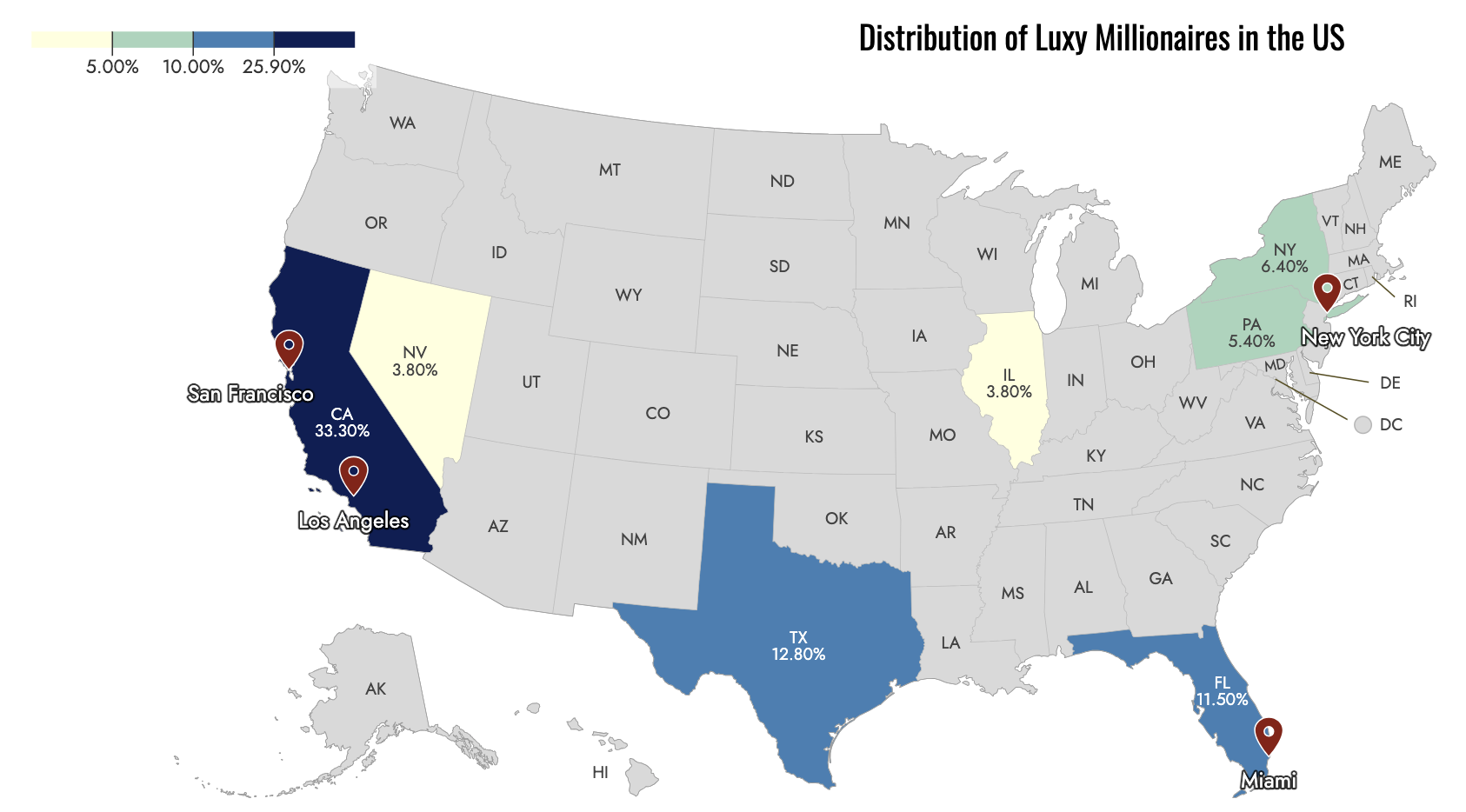
The Golden State Shines: California's Dominance (33.3%)
California comes first, attracting 33.3% of Luxy’s US-based HNWI respondents. This dominance is hardly surprising, given California's status as a global hub for technology, entertainment, and innovation. The state's diverse economy, coupled with its desirable climate and lifestyle, makes it an irresistible draw for those seeking both financial success and personal fulfillment.
Los Angeles and San Francisco Lead the Charge:
Within California, Los Angeles and San Francisco are the most frequently mentioned cities. Los Angeles, with its thriving entertainment industry and luxury real estate market, attracts entrepreneurs, executives, and creatives alike. San Francisco, the heart of Silicon Valley, is a magnet for tech titans and venture capitalists.
Texas: Big Wealth in the Lone Star State (12.8%)
Texas, with 12.8% of our US-based HNWI respondents, secures the second spot. The state's business-friendly environment, lack of state income tax, and booming energy sector make it an attractive destination for wealth creation and preservation.
Dallas: A Rising Star:
Dallas stands out as a prominent metropolitan area within Texas. The city's strong economy, affordable cost of living (compared to coastal cities), and growing cultural scene are attracting a new wave of affluent residents.
Sunshine and Savings: Florida's Tax Haven Appeal (11.5%)
Florida, with 11.5% of our US-based HNWI respondents, benefits from its warm climate, beautiful beaches, and favorable tax policies. The absence of state income tax, coupled with a relatively low cost of living, makes Florida a popular choice for retirees and those seeking to maximize their wealth.
Miami: A Global Playground:
Miami, with its vibrant nightlife, luxury real estate, and international flair, is a major draw for HNWIs. The city's growing financial sector and its proximity to Latin America make it a strategic location for global business.
The East Coast Contenders: New York and Pennsylvania (6.4% and 5.4% respectively)
New York (6.4%) and Pennsylvania (5.4%), while not as dominant as California, Texas, or Florida, still represent significant concentrations of wealth. New York City, as a global financial center, continues to attract high-earning professionals in finance, law, and media. Pennsylvania, with its rich history, diverse economy, and proximity to major East Coast cities, offers a more understated appeal.
The Curious Case of Nevada and Illinois (3.8% Each)
Nevada and Illinois, both accounting for 3.8% of our US-based HNWI respondents, present an interesting contrast. Nevada, with its low taxes and entertainment industry, attracts a specific type of affluent individual seeking a more unconventional lifestyle. Illinois, anchored by the city of Chicago, offers a more traditional urban environment with a strong business community and cultural institutions.
Potential Explanations for the Tie:
- Different Appeals: Nevada attracts those seeking tax advantages and a vibrant entertainment scene, while Illinois appeals to those seeking a strong business environment and cultural amenities.
- Chicago's Influence: Chicago, as a major financial hub and cultural center, likely accounts for the majority of HNWIs in Illinois.
- Data Nuances: The relatively small sample size within these states could lead to statistical fluctuations, resulting in the same percentage despite potentially different underlying factors.
The geographical distribution of HNWIs within the United States reflects a complex interplay of economic opportunities, lifestyle preferences, and tax considerations. California, Texas, and Florida emerge as the dominant states, each offering a unique blend of attractions for affluent individuals. While New York and Pennsylvania maintain their presence, the equal representation of Nevada and Illinois highlights the diverse factors that influence residential choices among the wealthy. As we delve deeper into the demographics and habits of these individuals, we will gain a more nuanced understanding of the Luxy lifestyle.
2.2. Where the Wealth Resides: Geographical Hotspots in Western Europe
A European Perspective: Unveiling Wealth Across the Atlantic
While the United States dominates our survey responses, a significant 30% of our HNWI respondents reside in Western Europe. This provides valuable insight into the distribution of wealth and lifestyle preferences across the Atlantic. While certain major cities emerge as hubs, the European landscape reveals a more nuanced pattern of affluence, with smaller towns and regions also attracting a considerable share of wealthy individuals.
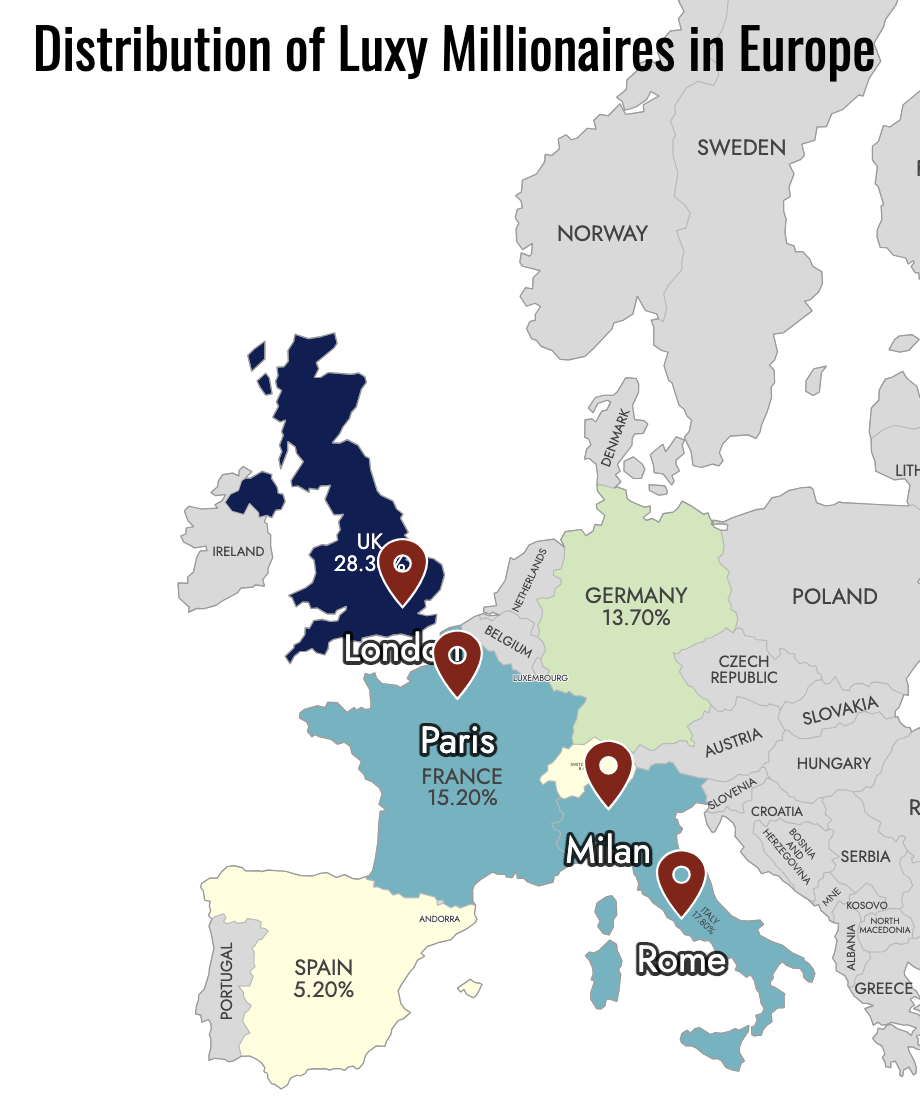
The United Kingdom: London's Magnetic Pull (28.3%)
The United Kingdom leads the way in Western Europe, attracting 28.3% of our European-based HNWI respondents. This dominance is largely attributed to London's status as a global financial center, a cultural powerhouse, and a hub for international business.
- London: A Global Metropolis: London stands out as the most frequently mentioned city in Western Europe. Its concentration of financial institutions, luxury real estate, and high-end amenities makes it an irresistible draw for affluent individuals from around the world.
Italy: HNWIs Attraction of the Dolce Vita (17.8%)
Italy, with 17.8% of our European-based HNWI respondents, offers a unique combination of historical charm, cultural richness, and luxurious living. The country's diverse regions, from the fashion capital of Milan to the art-filled streets of Florence, cater to a wide range of tastes and preferences.
- Rome and Milan: Centers of Attraction: Rome and Milan are the most prominent cities in Italy for HNWIs. Rome, with its ancient ruins and vibrant cultural scene, appeals to those seeking a blend of history and modernity. Milan, as a global fashion and design hub, attracts entrepreneurs and creatives in the luxury sector.
France: Elegance and Sophistication (15.2%)
France, with 15.2% of our European-based HNWI respondents, embodies elegance, sophistication, and a rich cultural heritage. The country's renowned cuisine, world-class art museums, and picturesque countryside make it a popular destination for affluent individuals seeking a refined lifestyle.
- Paris: The City of Lights: Paris, with its iconic landmarks, haute couture boutiques, and Michelin-starred restaurants, is a major draw for HNWIs. The city's reputation as a global center for art, fashion, and culture continues to attract affluent residents from around the world.
Germany, Switzerland, and Spain: A Different Distribution (13.7%, 8.6%, and 5.2% respectively)
Germany (13.7%), Switzerland (8.6%), and Spain (5.2%) present a contrasting picture compared to the UK, Italy, and France. In these countries, HNWIs on Luxy are less concentrated in major metropolitan areas and more dispersed across smaller towns and regions.
- Germany: While cities like Munich and Frankfurt hold economic significance, Germany's wealth is distributed across a network of smaller industrial and commercial centers. This reflects the country's decentralized economic structure and its emphasis on manufacturing and engineering.
- Switzerland: Switzerland's appeal lies in its political stability, low taxes, and high quality of life. HNWIs are drawn to the country's picturesque towns and villages, particularly in the Swiss Alps and around Lake Geneva, where they can enjoy privacy, security, and access to outdoor activities.
- Spain: While cities like Madrid and Barcelona attract some affluent residents, Spain's wealth is also distributed along its coastal regions and in smaller towns with rich cultural heritage. The country's warm climate, beautiful beaches, and relaxed lifestyle make it an attractive destination for those seeking a more laid-back existence.
Potential Reasons for the Distribution:
- Historical and Economic Factors: The distribution of wealth in Western Europe is influenced by historical patterns of trade, industrial development, and political structures. Countries like the UK and France, with their colonial past and centralized governments, have historically concentrated wealth in their capital cities.
- Tax Policies and Regulations: Tax policies and regulations play a significant role in attracting or deterring HNWIs. Countries like Switzerland, with their low taxes and strict banking secrecy laws, have traditionally been havens for wealth.
- Lifestyle Preferences: Lifestyle preferences also influence residential choices. Some HNWIs prefer the hustle and bustle of major cities, while others seek the tranquility and privacy of smaller towns and rural areas.
- Cultural and Social Factors: Cultural and social factors, such as language, cuisine, and social norms, can also play a role in attracting or deterring HNWIs.
The geographical distribution of HNWIs in Western Europe reflects a complex interplay of historical, economic, political, and cultural factors. While major cities like London, Paris, Rome, and Milan continue to attract a significant share of affluent individuals, the European landscape also reveals a more nuanced pattern of affluence, with smaller towns and regions offering unique attractions for those seeking a refined and fulfilling lifestyle. This diverse distribution underscores the importance of understanding the specific factors that drive residential choices among the wealthy in different European countries.
3. Leisure & Lifestyle: How the Wealthy Unwind
Wealth, beyond its material manifestations, unlocks access to a world of experiences and opportunities for personal enrichment. For High-Net-Worth Individuals (HNWIs), leisure time becomes a canvas for pursuing passions, cultivating interests, and engaging in activities that provide both relaxation and intellectual stimulation. In this chapter, we delve into the leisure pursuits of Luxy members, exploring the diverse range of hobbies and activities that define their lifestyles.
Wealth, beyond its material manifestations, unlocks access to a world of experiences and opportunities for personal enrichment. But does affluence necessarily translate into exotic or extravagant hobbies? Do millionaires pursue super-exclusive passions, or are their interests more down-to-earth? Surprisingly, for millionaires on Luxy, leisure time often means time for modest passions, cultivating interests, and engaging in activities that provide both relaxation and intellectual stimulation. Below we take a closer Look at the Luxy member’s hobbies and activities that define their lifestyles.
3.1. Top 10 Hobbies Among Luxy's Millionaire Members
Our survey reveals a fascinating array of hobbies that capture the attention of Luxy's HNWI members. The data, allowing for multiple selections, provides a comprehensive view of their diverse interests.
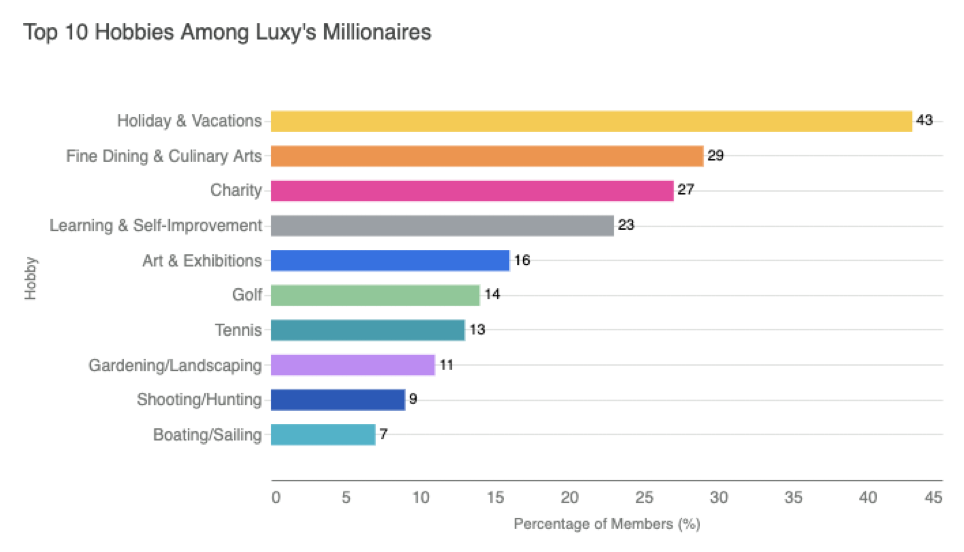
- Holiday & Vacations (43%): Exploration and Escape
Unsurprisingly, travel tops the list, with 43% of respondents citing "Holiday & Vacations" as a primary passion. For HNWIs, travel means more than regular package vacation, sun and free time: it's an opportunity for exploration, cultural immersion, and personal rejuvenation. From exotic destinations to secluded retreats, the world becomes their playground, offering a chance to escape the demands of their professional lives and create lasting memories. - Fine Dining & Culinary Arts (29%): A Taste for the Exquisite
Dining and culinary arts attract 29% of respondents, with a notable priority towards women. This suggests a deep appreciation for new gastronomic experiences, from savoring Michelin-starred cuisine to experimenting with new recipes of different cuisines at home. For these individuals, food is not merely sustenance but an art form, a source of pleasure, and a way to connect with different cultures. - Charity (27%): Giving Back and Making a Difference
A significant 27% of respondents engage in charitable activities, highlighting a commitment to social responsibility and a desire to make a positive impact on the world. For HNWIs, philanthropy is not just writing checks but regularly participating in causes they care about, leveraging their resources and influence to address pressing social issues in their communities. - Learning & Self-Improvement (23%): A Quest for Knowledge and Growth
The pursuit of knowledge and personal growth is a key motivator for 23% of respondents. This category encompasses a wide range of activities, from attending online courses and workshops to learning new languages and skills. Intellectual stimulation is a lifelong pursuit for millionaires, a way to stay engaged, expand their horizons, and remain competitive in a rapidly changing world. - Art & Exhibitions (16%): Appreciating Beauty and Creativity
Art and exhibitions appeal to 16% of respondents, with a higher proportion of women. This suggests a deep appreciation for aesthetics, creativity, and cultural expression. From visiting world-renowned museums to collecting contemporary art, these individuals immerse themselves in the world of art, finding inspiration and enrichment in the works of others. - Golf (14%): The Strategic Game of Leisure
Golf, with 14% of respondents, is a popular pastime, particularly among men. Beyond the physical exercise and outdoor enjoyment, golf offers a unique blend of strategy, skill, and social interaction. For HNWIs, the golf course serves as a place to relax, network, and engage in friendly competition. - Tennis (13%): The Thrill of the Court
Tennis, with 13% of respondents, is another popular sport, also favored by men. The fast-paced nature of the game, the physical challenge, and the opportunity for social interaction make it an appealing activity for those seeking both exercise and entertainment. - Gardening/Landscaping (11%): Cultivating Beauty and Serenity
Gardening and landscaping attract 11% of respondents, with a significant male presence. This hobby extends beyond simply tending to plants; it encompasses activities such as caring for their land and engaging in physical activities like chopping wood. For HNWIs, gardening and landscaping offer a connection to nature, a sense of accomplishment, and a way to create a beautiful and serene environment around their homes. - Shooting/Hunting (9%): The Pursuit of Skill and Tradition
Shooting and hunting, with 9% of respondents, are predominantly male activities. These pursuits offer a unique blend of skill, tradition, and connection to nature. For HNWIs, shooting and hunting may represent a way to challenge themselves, hone their skills, and connect with a long-standing heritage. - Boating/Sailing (7%): Embracing the Open Water
Boating and sailing, with 7% of respondents, are also primarily male-dominated hobbies. These activities offer a sense of freedom, adventure, and connection to the marine environment. For HNWIs, owning and operating a boat or yacht represents a symbol of success and a gateway to exploring the world's oceans and waterways.
It turns out the hobbies of most millionaires on Luxy are not about private islands and rocket science. Their passions are surprisingly relatable, yet different from the every day guy. Sure, they are not limited to anything, but their downtime often revolves around things many of us enjoy: traveling to see the world, giving back to causes they care about, and working on becoming better versions of themselves. The core of their leisure time often reflects a desire for connection, growth, and simple enjoyment. It's a reminder that, even with a million or several in the bank, the things that truly bring happiness are often the things that connect us all. The hobbies and passions of Luxy's millionaires are not defined by extravagance, but rather by a pursuit of experiences and personal growth that resonate with people from all walks of life.
3.2 Where in the World? Millionaires' Favorite Getaways
Having found that of course millionaires like to travel, let’s explore where do they exactly choose to spend their precious vacation time. With the world at their fingertips, the destinations they select offer a fascinating glimpse into their preferences. HNWIs on Luxy primarily travel within the United States but also places in Europe are popular destinations.
American Escapes: Sun, Sand, and Slopes
Within the US, certain destinations consistently pop up on the millionaire radar. Think of it as a mix of classic luxury and outdoorsy adventure:
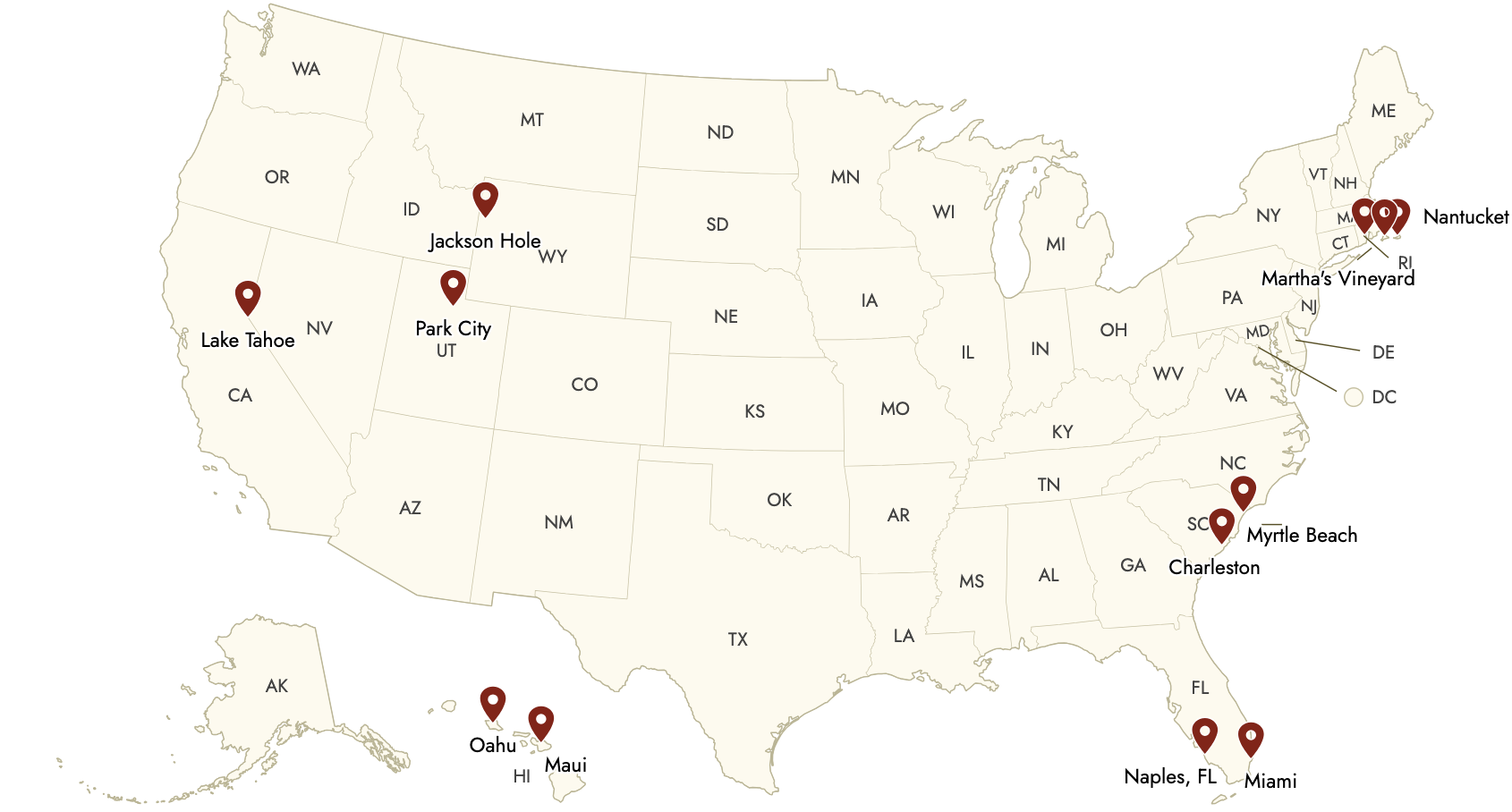
- Florida's Coasts (Naples, Miami, etc.): The allure of the Florida coast, particularly around Naples and the West Coast, is undeniable. Miami also remains a popular choice, offering a blend of vibrant city life and beautiful beaches.
- New England's Coastal Charms (Nantucket, Martha's Vineyard): For those seeking a more understated elegance, the coastal towns of New England, like Nantucket and Martha's Vineyard, provide a perfect escape. Rhode Island's coastline also holds appeal.
- Mountain Majesty (Jackson Hole, Park City, Lake Tahoe): When winter calls, the slopes beckon. Jackson Hole in Wyoming, Park City in Utah, and the Lake Tahoe region straddling California and Nevada offer world-class skiing and stunning scenery.
- Hawaiian Paradise (Oahu, Maui): The islands of Hawaii, particularly Oahu and Maui, remain a perennial favorite for their breathtaking landscapes, rich culture, and laid-back atmosphere.
- Southern Hospitality (Charleston, Myrtle Beach): The South, specifically around Charleston and Myrtle Beach in South Carolina, offers a blend of history, charm, and beautiful beaches.
European Adventures: From Coast to Culture
Across the Atlantic, Europe offers a diverse range of experiences that appeal to the discerning traveler:
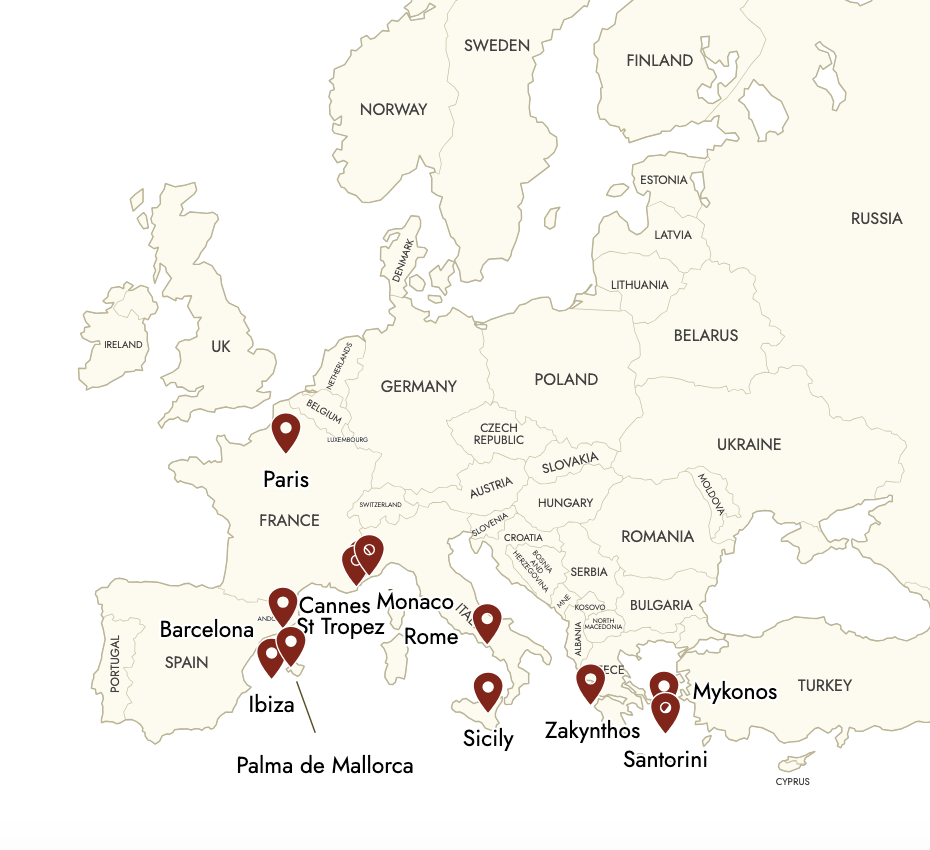
- French Riviera (Cannes, St. Tropez, Monaco): The South of France, with its glamorous destinations like Cannes, St. Tropez, and Monaco, continues to be a magnet for the wealthy.
- Italian Delights (Amalfi Coast, Sicily): Italy, with its stunning Amalfi Coast and the captivating island of Sicily, offers a blend of natural beauty, rich history, and culinary delights.
- Greek Island Hopping (Mykonos, Santorini, Zakinthos): The Greek Islands, with their iconic white-washed villages and crystal-clear waters, provide a picture-perfect escape. Mykonos, Santorini, and Zakynthos are among the most popular choices.
- City Breaks (Rome, Florence, Venice, Paris, Barcelona): Classic European cities like Rome, Florence, Venice, Paris, and Barcelona remain popular destinations for their rich history, art, and culture.
- Balearic Bliss (Ibiza, Palma de Mallorca): The Balearic Islands, particularly Ibiza and Palma de Mallorca, offer a mix of vibrant nightlife, beautiful beaches, and stunning scenery.
Relaxation, Adventure, or Culture? Millionaires' Travel Preferences
Beyond the "where," it's interesting to consider how millionaires like to travel. A recent survey sheds some light on their preferred vacation styles:
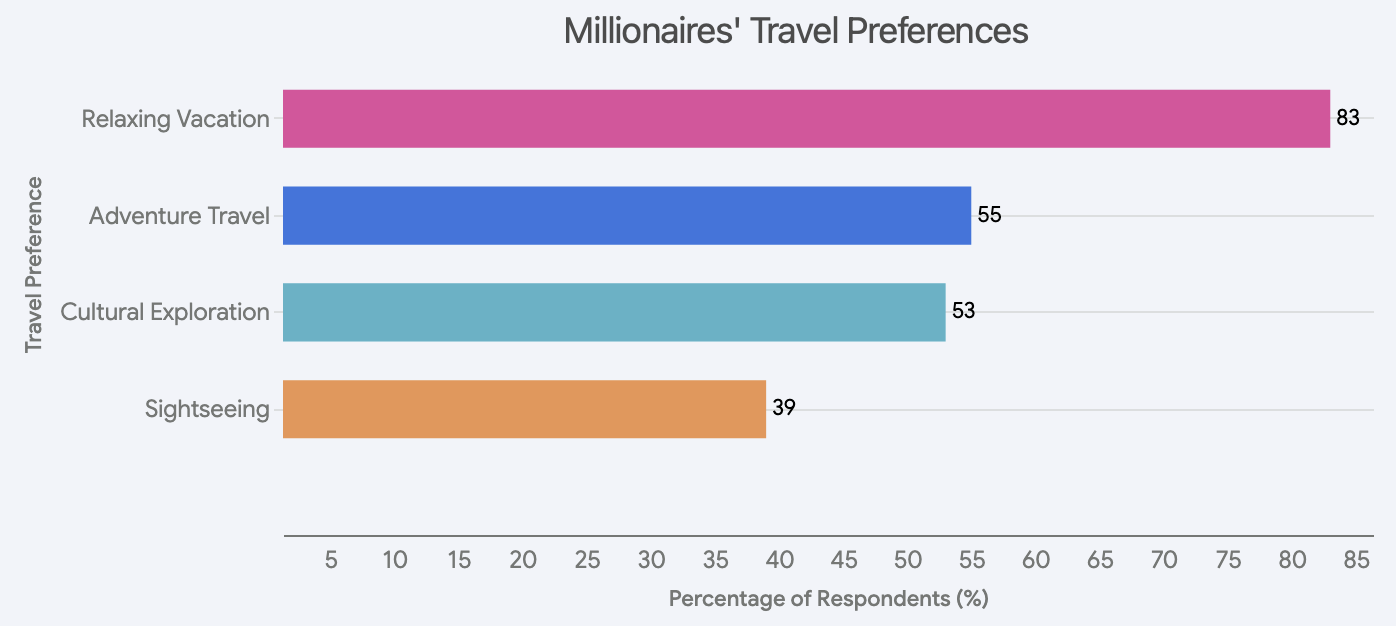
- Relaxing Vacation: A whopping 83% of respondents favored a relaxing vacation. This reinforces the idea that even the busiest among us crave downtime and tranquility.
- Adventure Travel: Over half (55%) enjoy adventure travel, suggesting a desire for excitement and pushing boundaries.
- Cultural Exploration: A similar percentage (53%) appreciate cultural exploration, highlighting a thirst for knowledge and understanding of different cultures.
- Sightseeing: While still popular, sightseeing came in at 39%, indicating that while seeing the sights is important, it's often combined with other elements like relaxation or cultural immersion.
Frequent Flyers: How Often Do Millionaires Travel?
Finally, let's look at travel frequency:
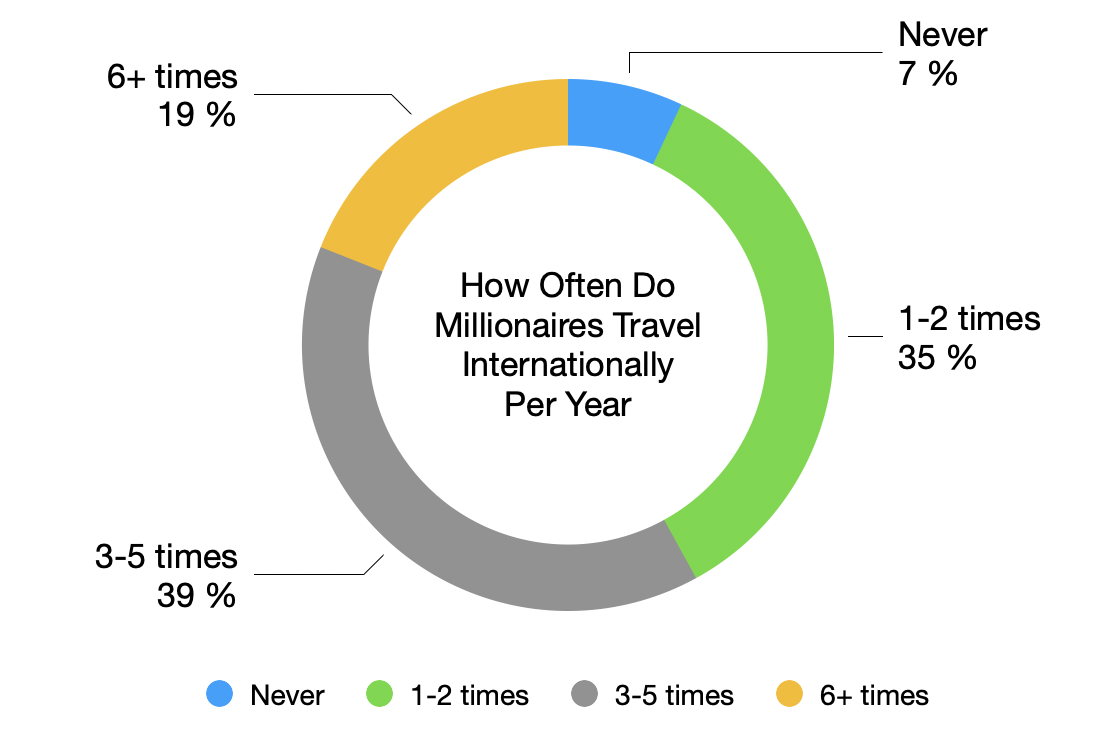
- Never: Only a small percentage (7%) reported never traveling internationally.
- 1-2 Times Per Year: Just over a third (35%) travel internationally 1-2 times per year.
- 3-5 Times Per Year: The largest group (39%) travels internationally 3-5 times per year.
- More Than 6 Times Per Year: A significant portion (19%) are frequent flyers, traveling internationally more than 6 times per year.
The Takeaway: A Blend of Relaxation, Exploration, and Frequent Travel
These travel habits paint a picture of millionaires who appreciate both relaxation and exploration. While they have the means to travel anywhere, their choices often reflect a desire for authentic experiences, cultural immersion, and, of course, a bit of well-deserved relaxation. The frequency of their travel, with a large percentage taking multiple international trips per year, underscores their global perspective and appetite for new adventures. It's not just about luxury; it's about experiencing the world.
3.3 Philanthropy: Giving Back as Part of the Millionaire Lifestyle
Beyond accumulating wealth, a significant portion of millionaires actively engage in philanthropic endeavors. According to our survey on Luxy, a notable 82% of millionaire members reported participating in philanthropy, demonstrating a commitment to giving back to their communities and supporting causes they believe in. This high percentage underscores the importance of social responsibility within this demographic.
The most prevalent category of philanthropic support, encompassing 52% of respondents, is directed towards religious organizations, poverty relief, education, and disaster aid. This suggests a strong desire among millionaires to address fundamental human needs and support institutions that provide essential services. The focus on local projects within this category is particularly noteworthy. Luxy members often volunteer their time and resources to organizations within their own communities, indicating a personal connection to the causes they support. For example, a millionaire might volunteer at a local soup kitchen, donate to a nearby homeless shelter, or contribute to a religious organization that provides community outreach programs. This hands-on approach suggests a desire to see the direct impact of their contributions.
Another significant area of philanthropic focus, representing 28% of respondents, is support for other human services, primarily addressing hunger and poverty. Similar to the previous category, these initiatives are often organized and supported locally. This highlights the importance of community-based solutions and the desire to address immediate needs within their own vicinities. The appeal of these organizations likely stems from their direct and tangible impact on individuals and families struggling with basic necessities. Millionaires may be drawn to the opportunity to provide immediate relief and contribute to improving the lives of those less fortunate in their communities.
Education also emerges as a key area of philanthropic interest, with 23% of respondents supporting educational purposes, such as initiatives that encourage youth participation in STEM (Science, Technology, Engineering, and Mathematics) fields. This demonstrates a forward-looking perspective and a recognition of the importance of investing in future generations. Examples of this type of philanthropy could include funding scholarships for students pursuing STEM degrees, supporting after-school programs that provide STEM education, or donating to organizations that promote STEM literacy in underserved communities. By supporting these initiatives, millionaires are contributing to the development of a skilled workforce and fostering innovation. For instance, a tech entrepreneur might establish a scholarship fund for students pursuing computer science degrees or donate equipment to a local school's robotics program. This type of giving aligns with a desire to promote long-term economic growth and opportunity.
Finally, 12% of respondents indicated that they volunteer for kids' sports activities, such as coaching or participating in other school programs. While this may seem less directly impactful than other forms of philanthropy, it highlights the importance of community involvement and supporting the development of young people. Coaching a sports team, volunteering at school events, or donating to school programs can have a significant impact on the lives of children, fostering teamwork, leadership skills, and a sense of belonging. This type of philanthropy reflects a desire to contribute to the well-being of their local communities and invest in the future of young people. It also suggests a willingness to contribute their time and expertise, not just their financial resources.
In conclusion, the philanthropic activities of Luxy's millionaire members reveal a diverse range of interests and a strong commitment to giving back. From supporting basic needs and religious organizations to investing in education and youth development, these individuals are actively engaged in making a positive impact on their communities and the world. The emphasis on local initiatives suggests a desire to see the direct results of their contributions and a personal connection to the causes they support. The high percentage of participation in philanthropy underscores the importance of social responsibility as a core value within this demographic.
Luxy's millionaires demonstrate a real commitment to improving their communities and the world. They often focus on local initiatives where they can witness the direct impact of their contributions. This hands-on approach suggests that giving back isn't merely an obligation, but a deeply personal desire. They address diverse issues, from immediate needs like hunger and poverty to long-term investments in education, revealing an understanding of complex challenges. Their wealth is viewed not just as personal gain, but as a tool for positive change. This reflects a shift towards a more conscientious view of wealth, where success is measured not only by financial accumulation but also by the positive impact one can make.
4. Conclusion and Outlook
The findings presented in this report provide a clear window into the evolving identity of the modern millionaire. Gone are the days when HNWIs were defined solely by "conspicuous consumption" or static displays of wealth. Today’s affluent demographic, as represented by the Luxy community, is defined by mobility, intellectual curiosity, and a profound commitment to social responsibility.
4.1 Implications for the Luxury Market and Dating Industry
The data suggests a significant shift in the luxury landscape. We are moving toward an era of "Quiet Luxury" and "Experiential Affluence."
With 43% of members prioritizing travel and 29% focusing on fine dining, the luxury market must pivot from selling "things" to selling "access" and "narratives." High-end brands should focus on the story and the experience rather than the price tag.
- The Rise of Conscious Dating: In the dating industry, wealth is no longer the sole gatekeeper. The high participation in philanthropy (82%) and self-improvement (23%) indicates that HNWIs are looking for value-alignment. Users are seeking partners who don't just share a tax bracket, but who share a commitment to local community impact and lifelong learning.
- Geographical Agility: The concentration of wealth in "tax havens" like Florida and "lifestyle hubs" like Italy highlights a "digital nomad" trend among the elite. The dating industry must adapt to a user base that is frequently international, traveling frequently, requiring seamless cross-border connectivity.
4.2 What This Means for Luxy
For Luxy, these trends confirm that the platform is more than a dating app, a lifestyle ecosystem. The high concentration of millionaire users in specific “hotspots”, such as California and London, provides Luxy with a roadmap for localized engagement. Furthermore, the almost humble passions of millionaire (gardening, tennis, learning) suggests that Luxy should continue to focus on authenticity and shared passions rather than just exclusive images.
As we look toward the 2030s, the Luxury Lifestyle will be defined by the impact a person leaves on the world, not just the assets they accrue. Luxy is uniquely positioned to be the premier architect of these high-value connections. By fostering an environment where wealth meets purpose, Luxy will continue to attract the world’s most influential individuals, ensuring that for its users, the best is always yet to come.