2025 Scam Prevention Report
Luxy could uncover a dramatic shift in its 2025 Scam Prevention Report, showing activities earlier from individual fraudsters to now highly organized, professional crime syndicates, preying on the aspirations of high-net-worth individuals. It’s long no longer about broken hearts and a few bucks lost, it's about sophisticated financial exploitation on a global scale.
1. Introduction to Fraudulent Activities in 2025
The digital landscape offers an abundance of opportunities for people to connect easily online. May it for finding the love of their lives, establish partnerships, or build friendships, online dating apps, in particular, have become a primary way for millions of singles seeking looking for like-minded individuals. And they are convenient and efficient. Within minutes, you can strike up conversations with interesting new people. However, this convenience also attracts a growing number of people with ill intentions. Scammers, always on the lookout to connect more victims, target in 2025 all online dating platforms, preying on universal human emotions and aspirations. This report takes a closer look at the changed online fraud, specifically examining the trends security experts on Luxy have observed and how Luxy employs strategies to proactively protect its members from these threats.
Luxy could reveal a significant and concerning shift in scam methodologies: from the individualistic romance scams of the past, we now face highly organized, professional operations predominantly focused on cryptocurrency and investment fraud, with a staggering 75% of these sophisticated attempts originating from specific regions in South Asia. These modern scammers are masters of psychological manipulation, employing emotional tricks to gain rapport and carry out schemes with faking “expert insights” and unique niche knowledge, to elaborate "passive income" opportunities, and pressuring users to quickly move conversations off-platform to evade detection.
In light of this escalating threat, Luxy has continuously upgraded its defense mechanisms. Luxy shares some of its scam detection mechanisms and how threats are addressed. Through a data-driven approach, Luxy can monitor suspicious actions across account creation, messaging, and user behavior. The Luxy system makes use of real-time location verification, collaborative intelligence with industry partners for blacklisting known scammer assets, and advanced messaging pattern analysis. Crucially, these technological defenses are augmented by a dedicated human review team, ensuring comprehensive oversight.
The robust scam prevention actions on Luxy are impressive: user safety is our priority, and result in over 95% of fraudulent actions and scam attempts being detected and neutralized before they can cause any harm to Luxy members. Through integration of technology, human expertise, and proactive user empowerment, Luxy remains dedicated to secure a trustworthy environment where genuine connections can flourish, free from the threat of online fraud.
2. Decoding 2025’s Online Dating Scam Trends
2.1 Scam Trends Monitored by Luxy
Online dating platforms provide a great and fast way to connect with new people, but also, unfortunately, open doors for unwanted danger. Fraudsters have long since realized that as well, preying on human emotions and aspirations. Since Luxy is a dating app predominantly used by HNWIs and millionaires, it was always seen as a tempting target for scammers. Recognizing this inherent risk, Luxy established in its founding year a state of the art security system and has always enhanced its scope. Not only to block suspicious attacks but also to carefully review a member base, aiming to identify risk early on before they occur.
In Luxy's early years, the landscape of scam attempts was characterized by a more individualistic approach. Fraudsters, often real people who had passed Luxy's picture verification, primarily engaged in classical romance scam tactics. This involved building trust and emotional rapport, only to later introduce an emergency or a compelling sob story, culminating in a request for financial assistance. These attempts were relatively scattered, with approximately 60% of all scam attempts falling into this category. Other fraudulent activities included false job offers (around 15%), attempts at identity theft (10%), and smaller-scale scams such as requests for gifts or gift cards (10%), after which the scammer would abruptly disappear and false investments at 5%.
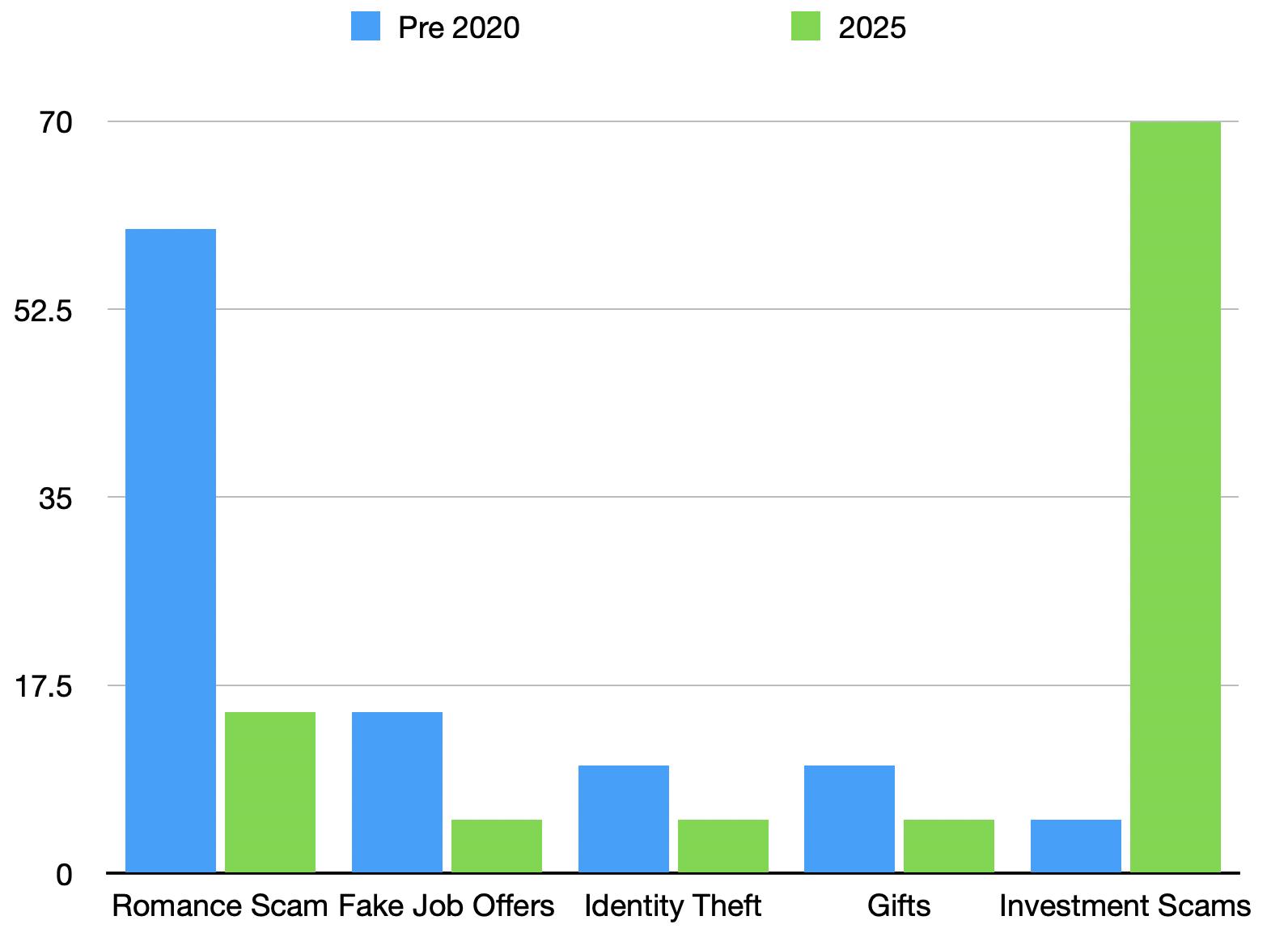
However, since 2020, Luxy has observed a significant and concerning shift towards more organized and professional scam operations. This evolution reflects a broader industry trend where individual opportunism has given way to sophisticated, team-based fraud, consolidated in company-like structures. Now in 2025, the vast majority of scam attempts fall into the category of investment and cryptocurrency scams. They dominate the list of around 70% of all fraudulent activities. These highly professional operations often involve complex narratives designed to lure victims into fake investment schemes. Classical romance scams, while still present, have diminished significantly, now representing only about 15% of scam attempts. The remaining threats include a smaller percentage of strange and fake job offers (5%) and requests for sensitive personal identity documents, such as passports, indicating a persistent focus on identity theft (5%). This data clearly illustrates a strategic pivot by fraudsters from emotional manipulation for direct financial aid to more intricate, high-value financial exploitation schemes.
2.2. Analysis of Common Scam Behaviors in 2025
The modern scammer is no longer a lone wolf operating in the shadows; they are often part of organized groups, exhibiting a level of sophistication that far surpasses the rudimentary attempts of a decade ago. This shift towards professionalized approaches of has led to more nuanced behaviors and meticulously crafted narratives designed to exploit specific vulnerabilities. Since 2020, these tactics have been increasingly subtle, leveraging psychological tricks and preying on the aspirations and emotional needs of people.
Luxy has uncovered their activities now in 2025 and can provide invaluable first-hand information of these emerging scam tactics. From our security team and user insights we gain crucial insights into the evolving patterns and common red flags that signal potential scams. While the most damaging scam attempts and messaging usually occur off the Luxy platform, once users have exchanged contact details to continue conversations, these user insights are critical for understanding the full scope of the threat.
Recognizing a few key indicators or talking points early can be the most effective defense against falling victim to sophisticated scams. These are not merely suggestions but critical red flags that demand attention. The following are the most common indicators that prevent being scammed everyone easily can familiarize.
a. The Fairytale of "Passive Income": Cryptocurrency and Investment Opportunities
This remains the most prominent and dangerous scam in 2025, directly linked to the rise of "pig butchering" schemes. Scammers initiate conversations by casually mentioning their success with "passive income" or other lucrative investment strategies. They present themselves as a friendly guide, "sharing" their knowledge of a "secret" or "guaranteed" investment, often in cryptocurrency, forex, or other digital assets. They might share convincing screenshots of fake profits or discuss complex financial jargon to appear legitimate. The insidious trap lies in leading victims to fake investment platforms, entirely controlled by these fraudsters. Once funds are sent, victims find themselves unable to withdraw their money, it simply vanishes.
How to react: Any unsolicited mention of investment opportunities or cryptocurrency, especially early in a conversation, should be treated as an immediate and severe warning sign. Especially when on a dating platform, you are here to get to know someone’s characteristics what they are looking for in a relationship and not to learn investment tricks. Don’t be fooled by their tactics. They want to get you to invest on a fake platform and besides casual talk will keep circling back to that topic. Cease communication and block the contact.
b. The Rush to Leave the Platform: Requests to Switch to External Messaging
This tactic is a cornerstone of almost every scam. Its purpose is clear: to move the conversation off Luxy's (and other dating apps') monitored platform, where scammer behavior and keywords are actively detected. Scammers will often express a desire for "more personal" or "faster" communication, suggesting WhatsApp, Telegram, Instagram or direct texting (with a simple purchased VOIP number). They might claim to be too busy for the app, or that their subscription is ending soon.
How to react: Users should resist any pressure to move off-platform prematurely. Don’t accept excused like, “I am rarely here” or “It’s easier to talk elsewhere”. They made an effort to create a profile, so they also are able to stay on the app to talk. Legitimate connections will understand the need to build trust within the secure environment of Luxy or other dating platforms. Scammers are often reported and banned within hours on Luxy, especially if they send similar messages or are flagged by multiple users. If users remain on the platform, communication is cut upon a ban, keeping them safe.
c. The Fabricated Persona: Inconsistent or Vague Personal Details
Scammers often juggle multiple fake identities, and while their stories can be polished, they frequently contain cracks under scrutiny. They might provide conflicting information about their job, location, family, or past experiences. They tend to be evasive when asked for specific details or offer generic, stock answers. A common tell is their lack of knowledge about the town they supposedly reside in, making mistakes with local time zones, or trying to change the subject when pressed. Their job descriptions, if pushed for explanation, often sound fishy or overly generalized.
How to react: Pay close attention to discrepancies. A simple cross-reference of details mentioned in different conversations can quickly reveal inconsistencies and expose a fabricated identity.
d. The Whirlwind Romance: "Love Bombing" and Intense Emotional Connection Too Soon
Scammers are masters of emotional manipulation, aiming to create a strong emotional bond rapidly to bypass rational thought. They will declare deep affection, proclaim "soulmate" connections, or make elaborate future plans (marriage, moving in together) within days or weeks of initial contact, often without ever having met in person or even video called. They meticulously mirror the user's interests and desires, creating an intense, almost overwhelming sense of connection. Despite these grand plans, they consistently avoid any direct contact, even video calls, while still making promises to meet "soon."
How to react: Be wary of anyone who seems "too good to be true" or rushes emotional intimacy. Genuine relationships develop organically over time, not in a hyper-accelerated fantasy.
e. The Elusive Figure: Refusal or Constant Excuses for Not Video Calling or Meeting in Person
This is a classic and undeniable indicator of catfishing or a scammer whose profile does not match their true identity. They will have an endless string of excuses: "bad internet," "camera broken," "on a business trip in a remote area," "too shy," or "waiting for the perfect moment." They might even make plans to meet in person, only to conjure up last-minute, often dramatic, excuses why the date or physical meeting cannot take place.
User Action: Insist on a video call to verify identity. If they consistently refuse or make endless excuses, it's a major red flag. If someone is unwilling to meet you in person or makes repeated excuses, they are likely not genuinely interested in a dating relationship, and communication should be ended.
2.3. Psychological Manipulation Tricks
Fraudsters are not just opportunistic, in 2025 they are professionally organized, masters of psychological manipulation, oozing fundamental emotional triggers to achieve their illicit goals.
- Exploiting Loneliness and Desire for Connection: At the core of many scams is the targeting of individuals looking for a genuine connection. Fraudsters provide intense attention, validation, and a seemingly perfect match, effectively filling an emotional void and creating a powerful bond built on false pretenses.
- Leveraging Empathy and Altruism: They craft elaborate sob stories or sudden crises, a sick family member, a lost wallet, a lawsuit, a lost passport while abroad specifically designed to elicit sympathy and a desire to help. This tactic is particularly effective with compassionate individuals who genuinely want to alleviate suffering.
- Tapping into Aspirations: For HNWIs, scammers often appeal to desires for further financial growth, unique investment opportunities, self improvement and a door opener to exclusive social circles. They frame their scam as a pathway to greater success, wealth, or an elevated lifestyle, making the scheme seem like a legitimate opportunity.
- Creating a Sense of Scarcity or Urgency: Scammers skillfully instill a fear of missing out (FOMO) or a pressing need for immediate action. Whether it's an "expiring" investment opportunity or an "urgent" financial crisis, this pressure bypasses rational decision-making, forcing victims to act impulsively.
- Building a Shared Identity: They quickly identify and mirror the victim's values, interests, and aspirations. This creates a powerful illusion of deep compatibility and understanding, making the victim believe they have found someone truly special who "gets" them.
2.4. Trust Building Scam Strategies: The Art of Deception
The foundation of any successful scam is the creation of trust, no matter how false. Scammers employ sophisticated strategies to build this deceptive bond:
- Mirroring and Pacing: Scammers carefully observe and imitate the victim's communication style, interests, emotional responses, and even life goals. This creates an artificial sense of rapport and deep connection, making the victim feel profoundly understood and compatible with the scammer.
- Fabricated Vulnerability: To appear relatable and trustworthy, scammers often share "personal" stories of past hardship, betrayal, or loneliness. These fabricated vulnerabilities are designed to elicit empathy and encourage the victim to reciprocate by sharing their own intimate details, deepening the false bond.
- Consistent, High-Frequency Communication: They bombard the victim with messages, calls, and expressions of affection, establishing a constant presence in their life. This high-frequency interaction rapidly deepens the perceived emotional bond, making the relationship feel more real and significant than it actually is.
- Future Pacing: Scammers frequently discuss elaborate future plans, travel together, how life will look like when they finally meet, shared business ventures, or even moving in, to solidify the emotional investment. These discussions make the relationship feel special, real and long-term, further entrenching the victim's commitment.
- "Expert" Persona: Especially prevalent in investment scams, they project an image of financial success and someone smart with exclusive niche knowledge. They position themselves as a trusted guide to wealth, offering to "help" the victim achieve financial success through their "proven" methods.
3. Scam Trends: Origins & Classification
Understanding the operational landscape of scammers is crucial for effective prevention. Luxy's robust monitoring systems and invaluable user reports provide a unique window into where these scams originate and how they manifest on the platform. This chapter delves into the geographical origins of scam attempts and the specific tactics employed, offering insights derived directly from Luxy's data.
3.1. Where Are They Launched From and What Type of Scams Are They?
While professional scammers employ sophisticated methods to mask their true locations, including proxy servers, occasional slip-ups or patterns in network traffic allow Luxy to trace their general origin. These insights reveal a distinct geographical distribution, often correlating with specific scam methodologies.
Our data indicates that the majority of scam attempts targeting Luxy users originate from a few key regions:
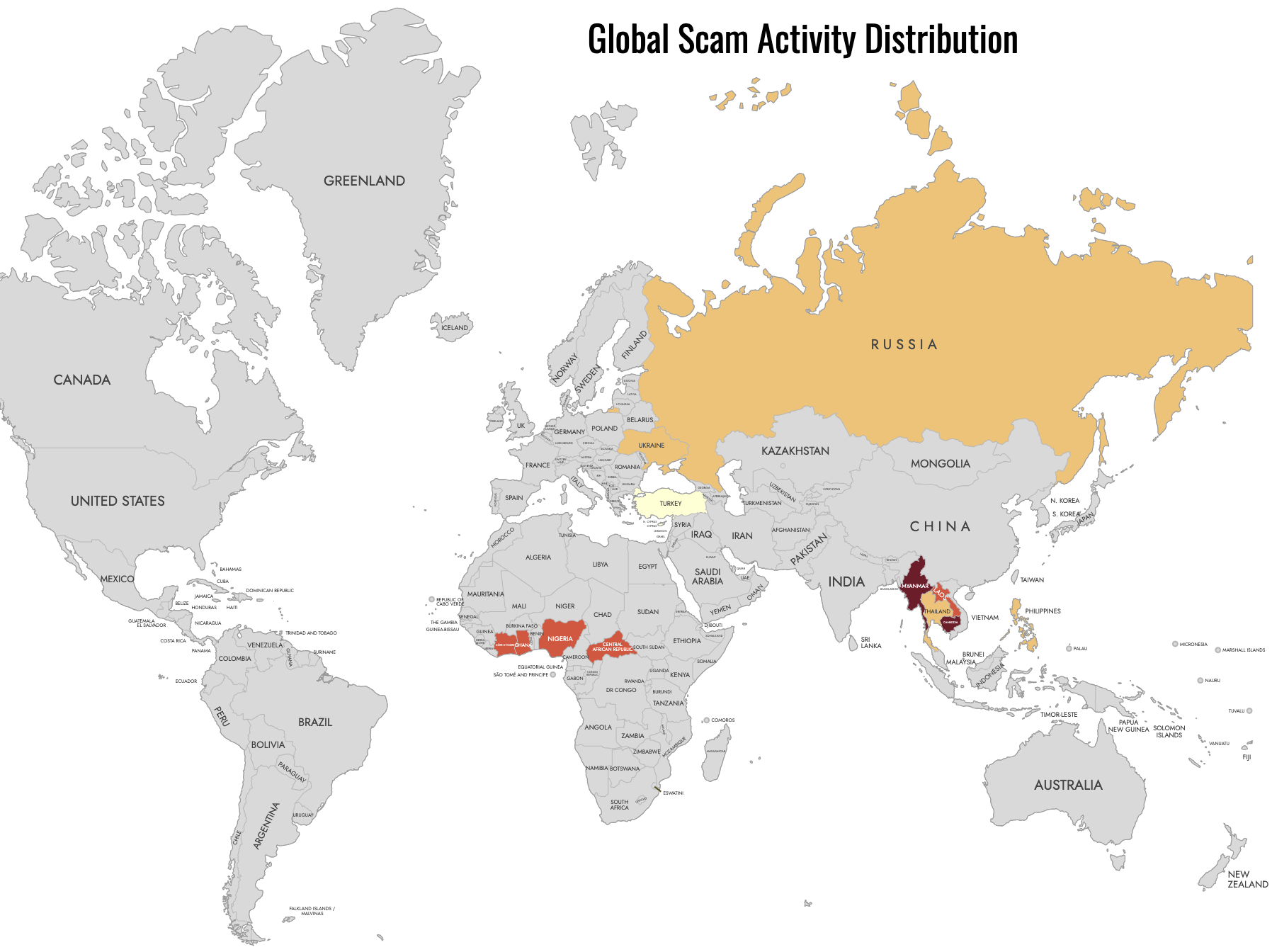
- South Asia (Roughly 75% of detected scams)
This region is a significant hub for organized scam operations which are located in the countries listed below.
Cambodia (30%), Myanmar (25%), Laos (15%): These countries, located in a triangle in Southeast Asia, have become notorious centers for large-scale, organized online fraud operations, often involving forced labor. Economic conditions, coupled with lax regulations and the presence of organized crime syndicates, create fertile ground for these activities. Scammers here often operate from dedicated "scam compounds" or call centers, running highly professionalized schemes.
Thailand (5%) and Philippines (5%): While also present, these locations show less scam activities compared to their neighbors, mainly for being more stable. However, similar sophisticated operations originate from here. - Central Africa (roughly 10% of detected scams)
Ghana, Nigeria, Central African Republic, Ivory Coast: These nations have long been associated with online fraud, often due to economic disparities and established networks of cybercriminals. The infrastructure for simpler romance type scams is well-entrenched. - Russia and Ukraine (roughly 10% of detected scams)
The geopolitical situation and a strong existing cybercrime ecosystem contribute to these regions being sources of scam activity. Highly skilled individuals, sometimes operating independently or in smaller groups, leverage their technical prowess. - Turkey and Cyprus (roughly 5% of detected scams)
These locations, often acting as transit points or regional hubs, show a smaller but distinct pattern of scam types.
3.2. The Interesting Pattern: Scam Types by Location
The geographical origin often correlates with the type and sophistication of the scam, reflecting local expertise, resources, and target demographics:
- South Asia (Cambodia, Myanmar, Laos, Thailand, Philippines): Exclusively Sophisticated Investment Scams (Investment Scams)
Scammers from these regions almost exclusively focus on highly sophisticated investment scams, commonly known as "pig butchering”. These are elaborate, long-term cons designed to build deep emotional trust before convincing victims to invest large sums in fake platforms. The "why" here is multi-faceted: these operations are often run by large, organized syndicates with significant resources, including technical infrastructure for creating fake trading platforms and training for psychological manipulation.
- Central Africa (Ghana, Nigeria, Central African Republic, Ivory Coast): Simpler Romance Scams
Scam attempts from Central Africa tend to be simpler, focusing primarily on classic romance scams. These often involve fake profiles designed to elicit emotional attachment quickly, followed by requests for money due to fabricated emergencies (e.g., medical bills, travel expenses). The "why" is often linked to economic desperation and a well-established history of these types of scams, which require less technical infrastructure than investment scams but rely heavily on emotional manipulation and a high volume of attempts.
- Russia and Ukraine: Investment Scams and Gift Requests via Sob Stories
Scammers from Russia and Ukraine engage in a mix of investment scams (though perhaps less frequently than South Asian groups) and scams involving requests for gifts or financial aid via elaborate sob stories. These narratives often leverage personal hardship, medical emergencies, or travel difficulties. This results due to a lack of economic possibilities, a high level of technical literacy, and a cultural context where direct appeals for help might be more common (e.g. women wanting to be courted), making these narratives resonate.
- Turkey and Cyprus: Identity Theft (Passport Info)
Scams originating from Turkey and Cyprus more often involve requests for real personal information, such as passport details, which are then used for identity theft. This could be due to regional expertise in document forgery, access to networks for selling stolen identities, or a strategic focus on exploiting personal data for various illicit purposes beyond direct financial transfer.
3.3. Analysis of Scam Behavior on Dating Platforms
Scammers understand that their window of opportunity on platforms like Luxy is often limited. Their activities are therefore highly strategic, focusing on quickly establishing contact and moving off-platform. Let’s take a further look at their practical management of online profiles and messaging patterns.
Account Creation and Profile Management:
- Recruitment of Real People & AI Assistance: Scammers often recruit real individuals to create profiles, using their genuine photos and basic details to bypass initial security checks on dating platforms. This makes detection challenging, as the profile itself appears authentic and is successfully verified. In more advanced operations, sophisticated programs and AI are employed to generate highly convincing fake profiles, complete with AI-generated images and biographies that mimic legitimate users. These AI-powered profiles are constantly evolving to evade detection.
- Distinguishing Fake from Real: To the human eye, these fake profiles can be incredibly difficult to distinguish from real ones. They often feature attractive, high-quality photos and well-crafted, albeit generic, biographies. However, Luxy's advanced detection systems analyze input patterns, metadata, behavioral anomalies, and cross-reference information that a human might miss, allowing the system to flag and often bar these inauthentic accounts.
Messaging Patterns and Objectives:
- The Race for Contact Information: The primary objective of a scammer once a profile is active on Luxy is to obtain the victim's phone number or other social media contacts (e.g. WhatsApp, Telegram, Instagram) as soon as possible. This urgency stems from the understanding that their activity on Luxy is usually based on a limited time window.
- Limited Time Window: Scammers know that their profiles are under constant scrutiny. They anticipate being reported and banned, often within hours or days, especially if they send similar messages to multiple users or trigger specific keywords. Therefore, their strategy is to quickly establish rapport, make a compelling case for moving off-platform, and secure external contact details before Luxy's moderation team can intervene.
- Off-Platform Operation: Once the conversation moves off Luxy, the scammer operates without the platform's oversight, making it significantly harder for Luxy to monitor, intervene, or gather evidence. This is why users are consistently advised to remain on the platform until a genuine level of trust is established.
3.4. System Enhancements for Scam Detection
Recognizing the evolving sophistication of scammers, Luxy has invested heavily in state-of-the-art detection and prevention systems. These technological advancements, combined with human oversight, form a multi-layered defense designed to protect users proactively.
Overview of Luxy's Enhanced Scam Detection Systems and Technologies
Luxy employs a sophisticated, multi-faceted system that continuously monitors for suspicious actions across various touch points, including account creation, messaging content, and behavioral patterns.
- Real-time Location Verification: One of the most effective proactive measures is Luxy's ability to cross-reference user location data. The system meticulously checks the real-time IP address of a user against their phone's geo-location data. If a significant mismatch is detected – for instance, an IP address indicating a user is in one country while their device's GPS places them in another – the profile is immediately flagged and often banned. This mechanism directly combats scammers' attempts to mask their true origin using VPNs or other anonymization tools, ensuring that users are genuinely where they claim to be.
- Collaborative Intelligence and Blacklisting: Luxy doesn't operate in isolation. We actively collaborate with other platforms and industry partners to identify confirmed scammers early on. This shared intelligence allows us to preemptively blacklist individuals or groups known for fraudulent activities. Furthermore, Luxy maintains its own extensive knowledge-based database. If blacklisted devices, specific locations, IP addresses, or even images have been previously associated with scam attempts, they are permanently blocked from being used again on the platform. This creates a powerful deterrent, making it increasingly difficult for repeat offenders to re-enter the Luxy ecosystem.
- Advanced Messaging Pattern Analysis: Our systems continuously analyze messaging patterns for keywords, phrases, and behavioral anomalies indicative of scamming attempts. This includes detecting pressure to move off-platform, requests for personal information, or the use of "love bombing" language too early in a conversation.
- Dedicated Review Team: Complementing our technological defenses is a dedicated and highly trained review team. This team constantly checks flagged activities, investigates user reports, and intervenes swiftly. Their human intuition and understanding of nuanced scam tactics allow them to catch sophisticated attempts that might initially bypass automated systems. This combination of AI-driven detection and human expertise ensures comprehensive coverage and rapid response.
How Luxy’s Anti-Scam Measures Proactively Prevent Scams
These integrated systems work synergistically to prevent scams before they can cause harm:
- Deterrence at Entry: By blacklisting known scammer assets (IPs, devices, images), Luxy prevents many fraudulent actors from even creating an account or gaining a foothold on the platform.
- Early Detection & Elimination: The real-time location checks and advanced messaging analysis allow Luxy to identify and ban suspicious profiles often within hours of their creation or first interaction. This significantly limits the scammer's "window of opportunity" to engage with legitimate users.
- Disruption of Communication: By flagging and intervening in suspicious conversations, Luxy disrupts the scammer's primary goal: to move the interaction off-platform. This keeps users within Luxy's monitored environment, where they are safer.
- Continuous Learning: Every detected scam attempt, every blacklisted asset, and every user report feeds back into the system, refining our algorithms and enhancing our ability to predict and prevent future threats.
Impact of System Improvements on Scam Prevention Rates
The rigorous implementation and continuous refinement of these system enhancements have yielded remarkable results. Luxy's data indicates that over 95% of fraudulent actions and scam attempts are now detected and neutralized before they can create any harm to Luxy users. This high prevention rate underscores the effectiveness of our proactive defense strategy, providing a significantly safer environment for our community. While no system can guarantee 100% immunity, this figure demonstrates Luxy's commitment to staying ahead of evolving scam tactics and protecting our members.
Luxy's Education Initiatives
Beyond technological safeguards, Luxy believes in empowering its users with the knowledge to protect themselves. Education is a critical component of our anti-scam strategy:
- Contextual Prompts and Warnings: When our systems detect suspicious messages or keywords within a conversation, such as requests to switch to an external messaging app, mentions of investment opportunities, or attempts to solicit personal financial details, Luxy provides immediate, contextual prompts to the user. These in-app warnings serve as a real-time reminder of potential risks, advising users against sharing personal information or moving off-platform prematurely.
- Preventative Guidance: These prompts are designed to be clear and actionable, guiding users on best practices. For example, a prompt might appear stating, "Warning: Scammers often try to move conversations off Luxy. Please be cautious about sharing personal contact information or switching to other apps." This direct guidance helps users recognize red flags themselves and reinforces safe online behavior.
- Reinforcing Platform Security: By educating users on the risks associated with moving off-platform, Luxy reinforces the value of its secure and monitored environment. Users are encouraged to remain within the app until they have established a genuine level of trust, ensuring that Luxy's protective measures can continue to safeguard their interactions.
This multi layer approach, combining advanced technology with vigilant human oversight and proactive user education, forms the foundation of Luxy's commitment to maintaining a secure and trustworthy platform for its high-net-worth community.
4. Outlook Forging a Future of Trust and Connection:
The landscape of online connection is constantly evolving, and with it, the challenges posed by malicious actors. Effective scam prevention is not merely a reactive measure but a proactive, continuous commitment. For users, it means cultivating a healthy skepticism, understanding common red flags – such as requests for money, overly rapid declarations of love, or attempts to move conversations off-platform immediately – and utilizing the reporting tools provided by platforms. Education and vigilance remain the most powerful personal defenses. For platforms, it necessitates a multi-layered defense strategy: sophisticated AI and machine learning algorithms for real-time threat detection, rigorous human moderation, robust identity verification processes, and transparent reporting mechanisms. The most successful prevention strategies are those that foster a partnership between the platform and its informed user base.
At Luxy, this commitment to user safety is not just a feature; it is fundamental to our mission. We understand that our discerning members seek not just connections, but secure and genuine connections. Our dedication is unwavering, manifested through continuous investment in cutting-edge security technologies, the deployment of advanced behavioral analytics to identify suspicious patterns, and the tireless work of our dedicated safety teams. We are constantly refining our protocols, adapting to new scam methodologies, and collaborating with industry experts to ensure that Luxy remains a sanctuary for authentic relationships. Our promise is to provide an environment where trust can flourish, allowing our members to focus on what truly matters: building meaningful connections without the pervasive fear of fraud.
Looking ahead, the value of the online dating industry is inextricably linked to its ability to guarantee user safety. In an era where digital interactions are increasingly central to human connection, platforms that prioritize and effectively deliver security will be the ones that thrive. Trust is the ultimate currency, and a reputation for robust scam prevention not only attracts new users but also fosters loyalty and advocacy among existing ones. This commitment elevates the entire industry, moving it beyond past stigmas and solidifying its role as a legitimate and invaluable avenue for relationship formation. For platforms like Luxy, leading the charge in security innovation sets a benchmark, contributing to a healthier, more credible online dating ecosystem overall. The future of online dating is bright, predicated on the collective resolve to safeguard its users, ensuring that the pursuit of love, partnership, and friendship remains a joyful and secure journey for everyone.